Fractional IT vs. Automated Operations: Where Hours-Based Coverage Breaks Down
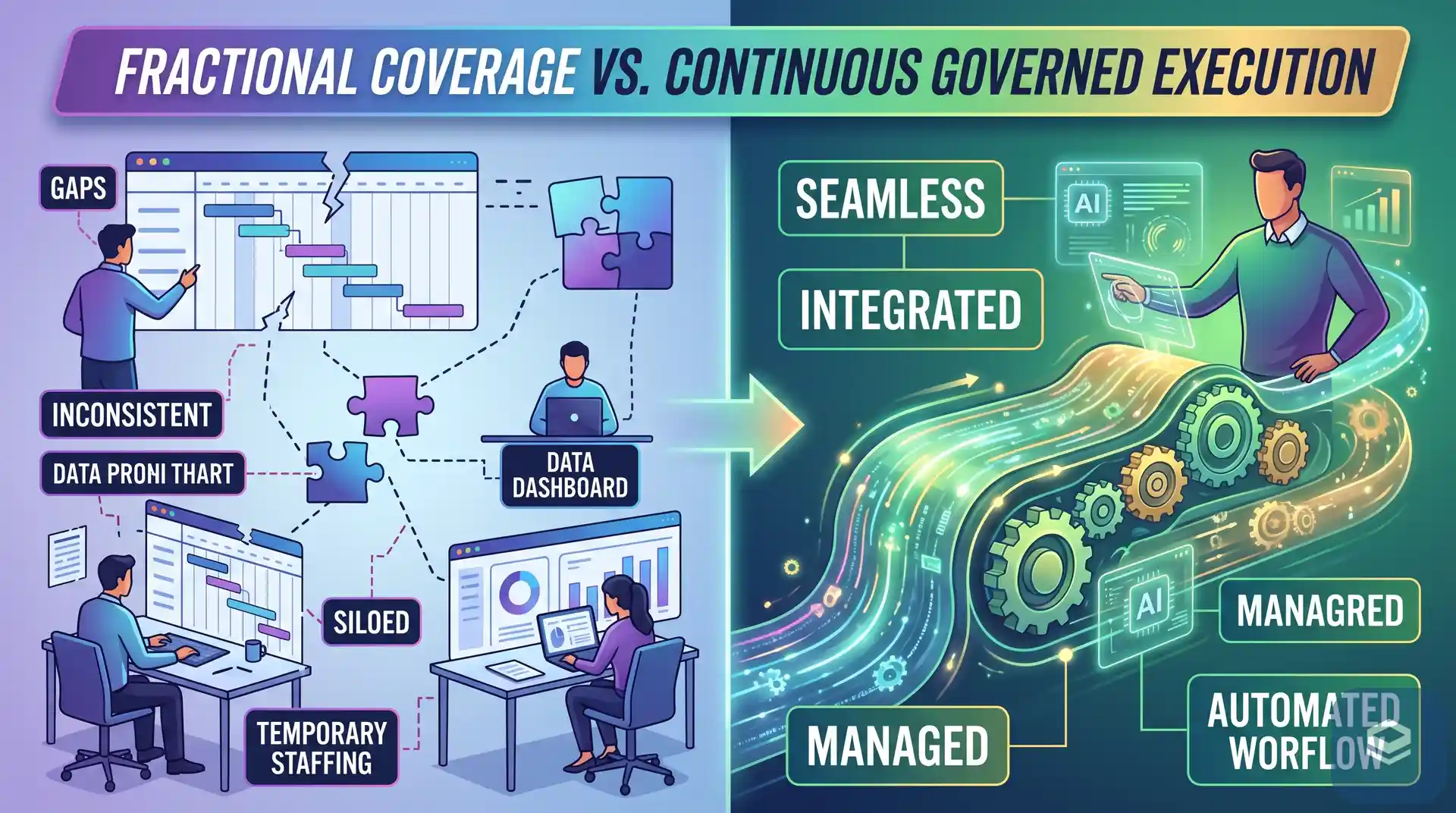
A fractional executive sells you senior judgment in scheduled blocks of hours. Governed digital labor sells you continuous execution under human approval, on an immutable audit ledger. These are not competing answers to the same question. Fractional coverage is priced on availability; digital labor is priced on work done. The model breaks at the same place for everyone who buys it: the interval between the blocks, when the work still needs doing and nobody is on the clock.
What is fractional IT — and fractional anything?
Fractional engagement is the purchase of a senior operator’s time at less than full time. A fractional CIO, CMO, CTO, or RevOps lead brings experience you could not justify hiring outright, on a retainer measured in hours or days per week.
It solved a real problem, and it still does. A mid-market company frequently needs the judgment of someone who has done the thing before, and needs it for far fewer hours than a full-time seat would cost. That is a genuinely efficient trade, and it is why the category grew.
The constraint is in the unit. You are buying availability, not throughput. The retainer guarantees that a qualified person will be reachable during agreed hours. It guarantees nothing about the volume of work that gets executed, because execution consumes the same finite hours that judgment does — and when both compete for one retainer, judgment loses first, because judgment is the part that can be deferred to next week without anything visibly breaking today.
What are the alternatives to fractional IT?
Four, and they are not interchangeable:
- Hire full time. Removes the hours ceiling, adds fixed cost, recruiting time, and ramp. Correct when the workload genuinely justifies a seat and you can defend the headcount.
- Managed services (MSP) or a retained agency. Moves from hours to a service scope. Coverage improves; you now depend on someone else’s queue and priority stack, and the work is still performed by people with finite hours — theirs instead of yours.
- Buy more software. Adds capability, adds a tool that needs an operator, and returns you to the original problem with an additional license. This is the loop the LaaS vs SaaS argument describes.
- Governed digital labor. Move the volume-bounded, rule-and-signal portion of the work to agents that execute continuously under a human approval gate, and keep the senior human for the judgment the retainer was actually worth paying for.
Option four is the one this page is about. It is also the one with a scope boundary worth stating plainly before you evaluate it.
Does MatrixLabX replace a fractional CIO?
No — and the honest answer matters more here than the convenient one.
MatrixLabX runs revenue, growth, and compliance operations. The PrescientIQ™ bundles execute prospecting, outbound, trial conversion, expansion, and compliance-governance work. They do not manage infrastructure, endpoints, networks, identity administration, vendor contracts, or a helpdesk. If your fractional engagement is genuinely an IT-infrastructure engagement, the right comparison for you is an MSP, not this.
What transfers is the argument, not the product: the reason hours-based coverage stops scaling is structural, and it applies identically to a fractional CIO, a fractional CMO, and a fractional RevOps lead. Where MatrixLabX competes directly is the second and third of those.
Stating this costs a conversion and buys the thing that is worth more: an accurate description of what we do, in the systems your buying committee is about to ask.
Why does hours-based coverage stop scaling?
Because the model has a ceiling that is arithmetic rather than managerial, and three things push into it at once.
The work is not scheduled, but the coverage is. Signals arrive when they arrive. A trial stalls, a lead converts, a rule changes, a record goes stale, an account shows intent. The value of acting on any of these is highest immediately and falls from there. A retainer covering agreed hours is, by construction, absent for most of the week — so the highest-value moment to act is frequently a moment nobody is working. That is a coverage problem, and no amount of diligence from a very good fractional operator resolves it.
Execution crowds out judgment. The retainer’s hours are one budget serving two purposes. Every hour spent building a list, updating a record, running a sequence, or assembling a report is an hour not spent on the strategy you retained the person for. Under pressure, the deliverable that has a deadline wins and the thinking gets pushed. You are paying a senior rate for work that did not require a senior person.
Adding hours scales cost linearly and output sublinearly. Doubling the retainer roughly doubles the cost. It does not double the output, because coordination overhead, context re-establishment at the start of each block, and handoff loss all grow with the arrangement. This is the same curve that SDR ramp cost produces in a headcount model, arriving by a different route.
What does continuous governed execution actually mean?
Precisely this, and not more than this.
Agent execution is not bounded by a retainer’s hours or by a business day, so the sourcing, enrichment, sequencing, monitoring, and record-keeping happen when the signal fires rather than at the start of the next scheduled block. That is the coverage change.
The approval gate is the part most “always-on AI” pitches leave out, and it is the part that makes this deployable. Consequential actions do not dispatch unsupervised. They are prepared, staged, and executed under a human approval step, and every action — proposed, approved, blocked, executed — lands on an immutable audit ledger with the actor, the rationale, and the before-and-after state.
So the honest description of what changes is not “nothing ever waits.” It is: what waits, and for how long, changes shape. Under a retainer, the work waits for the next block of someone’s time. Under governed execution, the work is already done and staged; what waits is a named person’s approval on the subset of actions that warrant one, with lower-consequence classes pre-authorized to run inside guardrails you set. The queue moves from execution to judgment, which is the queue you actually want a senior person standing in.
That model is what MatrixLabX means by governed autonomy: agents execute, humans authorize.
How do the two models compare?
This table compares suitability, not performance. There is no cost-per-hour versus cost-per-agent row, because that comparison is only honest against your own numbers.
| Fractional coverage | Governed digital labor | |
|---|---|---|
| What you buy | A senior operator’s availability | Execution of a defined operational scope |
| Priced on | Hours or days per period | Outcomes; no seat licenses |
| Best at | Strategy, architecture, vendor judgment, escalation, org design | Sourcing, enrichment, sequencing, monitoring, record maintenance, evidence capture |
| Bounded by | Hours in the retainer | Scope of the governed workflow and the approval queue |
| Coverage between blocks | None | Continuous |
| Judgment | The reason you bought it | Stays human, at the approval gate |
| Auditability | Whatever got written down | Immutable ledger: actor, rationale, before/after state |
| Continuity when the person leaves | Context leaves with them | Context stays in the system |
| Scales by | Adding hours | Adding scope |
Read the two “Best at” rows together. They do not overlap. That is the actual finding of this comparison, and it is the reason the framing is not replacement. The work a fractional executive is genuinely worth their rate for is not the work a governed agent does, and vice versa. The inefficiency in the fractional model is not the person — it is that the retainer forces one budget of hours to fund both.
Is your operation paying senior rates for execution work?
The diagnostic below gives a directional read on where your retainer’s hours are actually going. It returns a governance recommendation, not a cost estimate.
Where are your retainer's hours going?
Five questions for a directional read on whether you are buying judgment or throughput. This tool returns a governance recommendation — it does not estimate hours or cost. That is modeled on your own data in the free AAR.
What should you do with this?
If your fractional engagement is mostly advisory and the execution capacity exists elsewhere, the model is working — leave it alone.
If your fractional operator is spending most of their hours executing, you have a coverage problem wearing an advisory contract, and the useful question is which parts of that execution are rule-and-signal work that never needed a senior human in the first place.
The way to answer that against real numbers rather than an argument is the Autonomous Audit Report — modeled on your own data, before any commitment.
The broader case for why execution capacity rather than software access is the mid-market constraint is in digital labor. How the approval gate and audit ledger work is on the PrescientIQ™ platform.
Model this against your own numbers
The Autonomous Audit Report maps where your execution hours actually go and what the same scope looks like under a governed workflow — built on your data, before any commitment.
Get your free AAR benchmarkFrequently asked questions
What is fractional IT?
Fractional IT is the engagement of a senior IT leader — often a fractional CIO or CTO — on a part-time retainer measured in hours or days per period, rather than as a full-time hire. The same model is used for fractional CMO, CFO, and RevOps roles.
What are the alternatives to fractional IT?
Four: hire full time, move to a managed service provider or retained agency, buy software and staff someone to operate it, or move the volume-bounded execution to governed agents and keep a senior human for judgment. Which fits depends on whether your constraint is judgment or throughput.
Is fractional IT worth it?
It is worth it when what you need is judgment you cannot justify hiring full time, and when execution capacity exists elsewhere in the organization. It stops being worth it when the retainer’s hours are consumed by execution, because you are then paying a senior rate for work that does not require seniority — and the strategy you retained the person for is what gets deferred.
Can AI agents replace a fractional CIO?
No. Infrastructure architecture, vendor selection, risk judgment, and escalation are judgment work and stay with a person. What agents take on is the rule-and-signal execution layer. MatrixLabX specifically runs revenue, growth, and compliance operations, not IT infrastructure.
What does “governed autonomy” mean in practice?
Agents execute; humans authorize. Consequential actions pass a human approval gate before dispatch, lower-consequence classes run inside pre-authorized guardrails, and every action lands on an immutable audit ledger recording the actor, the rationale, and the before-and-after state.
How is this priced compared with a retainer?
A retainer is priced on hours. MatrixLabX bundles are priced on outcomes, with no seat licenses. Which is cheaper for your operation is an empirical question about your workload, not a general one — it is what the Autonomous Audit Report models on your own data.