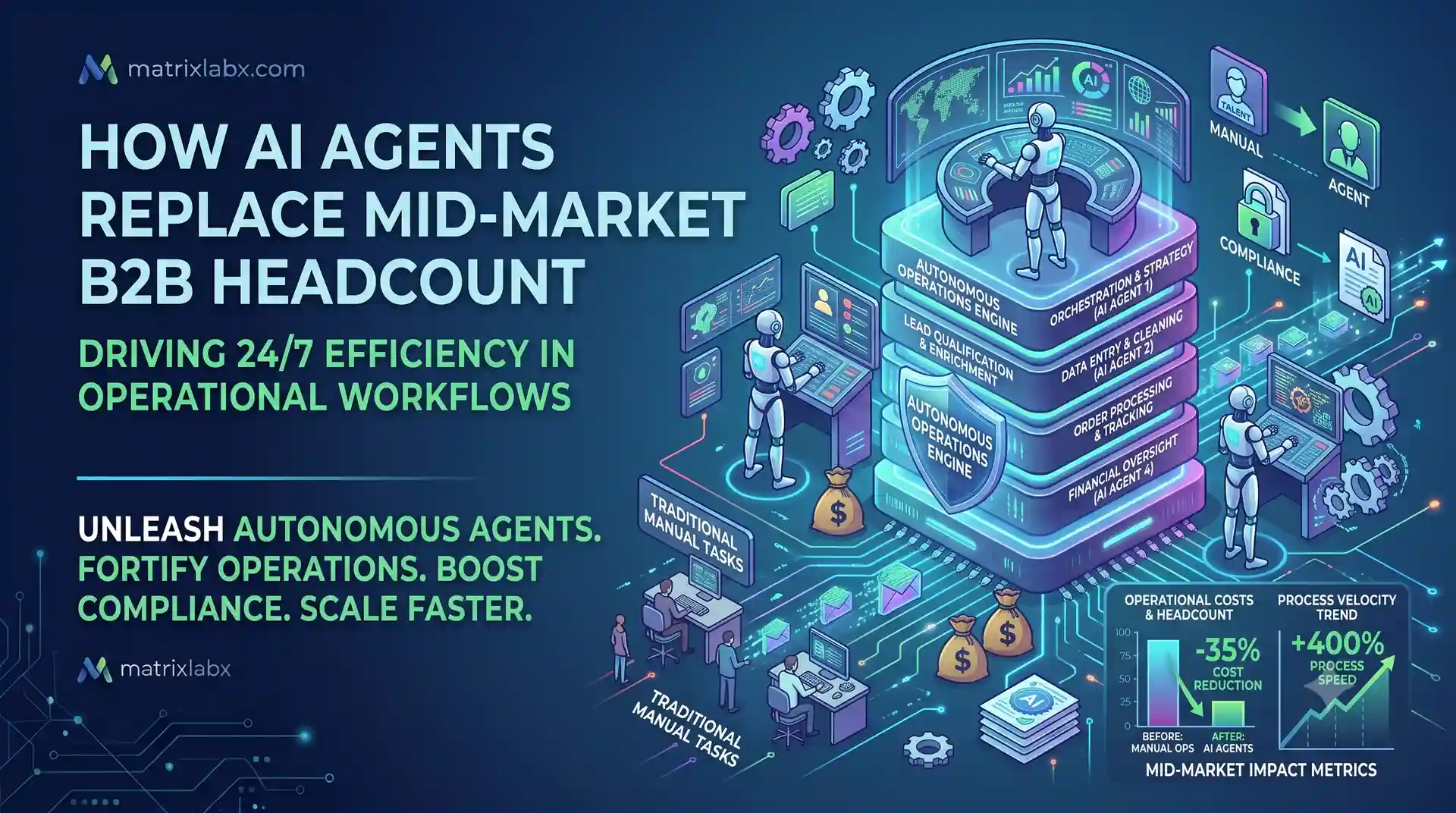
How autonomous AI agents replace headcount in mid-market B2B operations
Autonomous AI agents for mid-market operations are pre-trained, vertical-specific software workers that sense signals, decide, and execute business workflows continuously under customer-governed authority — absorbing the operational execution that mid-market teams would otherwise hire operators to perform. Instead of adding CRM admins, SDRs, and marketing-ops specialists to scale output, mid-market B2B companies deploy agents that run 24/7 at ≥99.5% availability SLO, with a named human approving every externally visible action.
Key takeaways
- →Autonomous agents absorb operational execution — not judgment. They run rules-based, high-volume work continuously so companies stop scaling output by scaling operational headcount.
- →A fully loaded mid-market SDR now costs an average of $127,000 per year. Agents carry the sequencing and follow-up load at a fraction of that, priced on workflow volume rather than seats.
- →Deployments complete in 21 days or less.
- →Human capital moves from manual execution to strategy, relationships, and exception handling — agents execute, humans authorize.
Who is MatrixLabX?
MatrixLabX is an autonomous AI agentic consulting firm deploying pre-trained, vertical-specific digital labor for mid-market enterprises — shifting operations from Software as a Service to Labor as a Service. PrescientIQ™ is the autonomous execution platform that analyzes company data and executes marketing, sales, and operational workflows under customer-governed authority. Built natively on Google Cloud.
What does it mean for autonomous AI agents to replace headcount?
It means the operational execution a role performs is carried out by software workers instead of salaried operators. A mid-market revenue function does not run on strategy alone. It runs on thousands of small, repeatable actions: updating records, sending sequences, reconciling data across tools, flagging compliance events, and chasing follow-ups. Historically, the only way to do more of that work was to hire more people to do it.
Autonomous agents break that dependency. An agent ingests the same signals a human operator would, decides the next action using causal models rather than correlational guesswork, and executes — with consequential actions routed through a human-approval step. The operational curve that once rose with every new customer flattens, because output is no longer tied to how many operators sit at keyboards.
According to McKinsey's 2025 research on generative AI in the enterprise, 60–70% of the hours in typical operational roles are spent on activities that are automatable with current AI capability. Gartner projects that by 2028, one-third of enterprise software will include autonomous agent capabilities, up from under 1% in 2024. The direction is not in question; the question mid-market leaders face is execution.
“The distinction between a copilot and an autonomous agent is not philosophical — it is a P&L line item. One tells your team what to do; the other does it.”— George Schildge, CEO & CAIO, MatrixLabX
Which mid-market operational roles do autonomous agents absorb first?
High-volume, rules-based execution roles absorb first — the functions with clear inputs, measurable outputs, and heavy manual load. These are the roles mid-market companies hire in clusters as they scale, and the roles where backlog grows fastest. The Revenue Accelerator Stack targets exactly this operational layer.
| Operational function | Traditional headcount approach | Autonomous agent approach |
|---|---|---|
| CRM administration | Dedicated admin; data decays between updates | CRM Janitor maintains 99.5% accuracy continuously |
| SDR sequencing & follow-up | SDR team at ~$127K fully loaded each | Agents run 6× SDR volume at 2.8× conversion |
| Marketing operations | Ops specialist builds and maintains flows | Agents build, launch, and adapt flows autonomously |
| Data reconciliation | Analyst hours reconciling across 14 tools | Continuous reconciliation across integrations |
| Compliance monitoring | Reactive review; violations found late | Compliance Shield flags events before they escalate |
Notice what is absent from the agent column: judgment-heavy work. Negotiating a complex deal, resetting quarterly strategy, or managing a key account relationship stays with humans. Agents take the execution load underneath those activities, which is where the hours — and the headcount requisitions — actually accumulate.
How much does operational headcount actually cost mid-market operations?
Far more than the salary line, because every operational hire carries loaded cost, tooling, and coordination overhead. A $50M–$200M ARR company scaling its revenue function feels this acutely: each new operator needs a seat in several SaaS tools, a manager's attention, and time to ramp. The Revenue Accelerator Stack reframes that spend as a single annual contract for digital labor.
| Cost component | Added operational headcount | Autonomous agent bundle |
|---|---|---|
| Fully loaded cost per SDR | ~$127,000 / year | Priced on workflow volume |
| Availability | ~2,000 productive hours/year | 24/7/365 · ≥99.5% availability SLO |
| Ramp time to productivity | 3–6 months | Deployment in 21 days or less |
| Tooling seats required | 5–14 SaaS seats per operator | Consolidates 14 tools → 1 |
| Output ceiling | Fixed by hours in a day | Scales with workflow volume |
| Data quality | Decays without discipline | 99.5% CRM accuracy maintained |
Forrester's 2025 automation research places the fully burdened cost of a knowledge-worker FTE at 1.25–1.4× base salary once benefits, tooling, and management overhead are counted. For a revenue operation adding ten operators over an 18-month growth phase, that overhead compounds into millions — before a single incremental dollar of pipeline is generated.
Three ways mid-market teams apply this in practice
Use case — CRM administration. Before: a $90M ARR SaaS company ran a two-person CRM admin function, yet reps still complained of stale records and duplicate accounts that skewed forecasting. After: the CRM Janitor agent took over deduplication, enrichment, and hygiene, holding data at 99.5% accuracy without manual cleanup sprints. Bridge: the admins were redeployed to revenue analytics, and the forecast became trustworthy for the first time in two years.
Use case — outbound sequencing. Before: a professional-services firm needed to double outbound but balked at hiring four more SDRs at roughly half a million dollars in loaded cost. After: autonomous prospecting agents ran the sequencing and follow-up at 6× the prior volume with 2.8× the conversion rate. Bridge: pipeline rose 82% in 90 days with zero new operational headcount, and the two existing SDRs focused only on live conversations.
Use case — compliance monitoring. Before: a FinTech operations team reviewed alerts manually and still missed events until they escalated. After: the Compliance Shield monitored continuously, cutting false positives 80% and surfacing genuine events early. Bridge: the team stopped drowning in noise and spent its hours on the exceptions that actually carried risk.
How do you deploy autonomous agents without interrupting operations?
Through a staged process that puts agents in monitoring mode first, then grants autonomy once behavior is validated. MatrixLabX completes deployments in 21 days or less. Operations leaders see the agents act on real signals before any autonomous execution is switched on, which is how the rollout avoids the operational shock that a rushed automation project would cause.
| Stage | What happens | Typical duration |
|---|---|---|
| 1. Context Ingestion | Agents ingest CRM data, stack config, and workflows inside your GCP tenant | Days 1–4 |
| 2. Agent configuration | Agents trained on your data; CRM Janitor begins parallel repair | Days 3–8 |
| 3. Staged go-live | Monitoring and escalation first, then autonomous execution | Days 6–12 |
| 4. Production validation | Every action logged to an immutable audit trail; SLAs confirmed | Days 10–15 |
The step-by-step operations rollout
- Map the operational load. Identify the rules-based, high-volume work absorbing the most operator hours — usually CRM hygiene, sequencing, and reconciliation.
- Pick one workflow to prove value. Start where the backlog is worst and the output is measurable, not where the politics are hardest.
- Run Context Ingestion. Connect the CRM and stack through APIs; all processing stays inside your Google Cloud perimeter.
- Deploy in monitoring mode. Let the agent observe and recommend before it acts, so the team builds trust in its decisions.
- Grant staged autonomy. Switch on autonomous execution for low-risk actions first; keep consequential actions behind a human-approval step.
- Instrument the P&L. Track pipeline velocity, CAC, and data accuracy against the pre-deployment baseline, not activity vanity metrics.
- Redeploy human capital. Move operators from manual execution to judgment, relationships, and exception handling.
- Expand to the next workflow. Consolidate redundant tools as agents absorb more of the operational layer.
“You do not replace a team on day one. You give the team back the hours it was losing to the keyboard, and let the P&L show you where the headcount curve should have bent.”— George Schildge, CEO & CAIO, MatrixLabX
Which model fits your operation? A quick decision guide
Use the guide below to gauge where autonomous agents fit your operations today. Each branch reflects a real deployment threshold MatrixLabX evaluates during discovery.
Are you about to add operational headcount to scale output?
Is your CRM data quality below 95% and drifting?
Do you run 10+ SaaS tools with heavy manual coordination?
Under $20M ARR with a single-channel motion?
Why might autonomous AI agents not replace headcount at your company?
Because the model has real prerequisites, and honest evaluation matters more than a pitch. Autonomous agents are not a fit for every operation. These are the conditions under which a deployment underperforms or should wait:
- Your workflows are undocumented and improvised. Agents execute defined processes. If the work lives only in people's heads, that has to be surfaced before automation.
- Your data is fragmented with no system of record. Without a CRM or reliable source of truth, agents have nothing trustworthy to act on until hygiene is established.
- Your volume is genuinely low. Sub-$20M ARR single-channel operations may not have the operational load to justify the model yet.
- Your bottleneck is judgment, not execution. If the constraint is strategy or relationships rather than manual hours, agents will not move the number.
- You cannot commit to governance. Autonomous execution requires human-approval design and audit discipline. If that ownership is not resourced, hold off.
The pattern where agents deliver most is unambiguous: a mid-market operation with real volume, a system of record, and a growing backlog it was about to solve by hiring. That is where the headcount curve bends.
What is the bottom line for operations leaders?
Autonomous agents change how operations are staffed, not just how they are tooled. The mid-market companies pulling ahead in 2026 are not the ones that bought another dashboard. They are the ones that stopped scaling output by scaling operational headcount, moved their people to the work only people can do, and let PrescientIQ™ platform overview carry the execution underneath.
FAQ: autonomous AI agents and mid-market headcount
What does it mean for autonomous AI agents to replace headcount?
It means the operational execution a role performs — data entry, sequencing, reconciliation, monitoring, follow-up — is carried out by pre-trained AI agents instead of a salaried operator. The agents run continuously under customer-governed authority, so companies stop adding operational headcount to scale output. Agents execute, humans authorize.
Which operational roles do autonomous agents absorb first?
High-volume, rules-based execution roles absorb first: CRM administration, SDR sequencing, marketing operations, data reconciliation, and compliance monitoring. These functions have clear inputs, measurable outputs, and heavy manual load. MatrixLabX deploys agents into these workflows in 21 days or less, starting with monitoring before autonomous execution.
Do autonomous AI agents mean laying people off?
Usually not directly. Most mid-market operations are understaffed against their backlog, so agents first absorb the work companies were about to hire for. Human capital shifts from manual execution to judgment, strategy, and exception handling. The measurable change is that output scales without the operational headcount curve rising with it.
How long does it take to deploy autonomous agents in operations?
MatrixLabX deployments complete in 21 days or less through a Context Ingestion process that handles integration, configuration, and production validation. Agents go live in stages — monitoring and escalation first, then autonomous execution — so operations leaders see behavior before granting full autonomy. Measurable P&L impact typically lands within 90 days.
How much operational headcount can one agent bundle replace?
It varies by workflow volume, not a fixed ratio. A single autonomous execution platform commonly absorbs the manual load of several operational roles — CRM admin, SDR sequencing, and marketing ops — while maintaining 99.5% CRM accuracy and ≥99.5% availability SLO. Pricing is tied to workflow volume, not per-seat headcount.
Will autonomous agents work with our existing CRM and tools?
Yes. PrescientIQ integrates with existing Salesforce and HubSpot instances through their APIs, so no migration is required. The CRM Janitor agent repairs and maintains data quality at 99.5% accuracy in parallel. Stack consolidation from 14 tools to one happens gradually as redundant point solutions are decommissioned over the first six months.
How do autonomous agents differ from AI copilots for operations?
A copilot waits for a prompt and suggests an action a person still executes. An autonomous agent senses signals, decides, and acts continuously, escalating only consequential actions for human approval. That difference is why autonomous agents deliver 4 times higher goal completion than copilot tools in production operations.
Ready to bend your operational headcount curve?
Book a 30-minute discovery call. Our team will map which operational workflows your agents should absorb first and give you an accurate deployment timeline.
Book a Discovery Call →George Schildge
CEO & Chief AI Officer, MatrixLabX
George Schildge is a pioneer of the Vertical Agentic Customer Platform and Systems.
Related posts
See where your own execution effort is going
The Autonomous Audit Report models where your team's execution capacity is currently spent, what your configuration is actually paying for, and what the governed alternative looks like on your own data — before any commitment.
Get your free AAR benchmark