SaaS churn signals: the eight to watch, how far ahead each moves, and the play for each
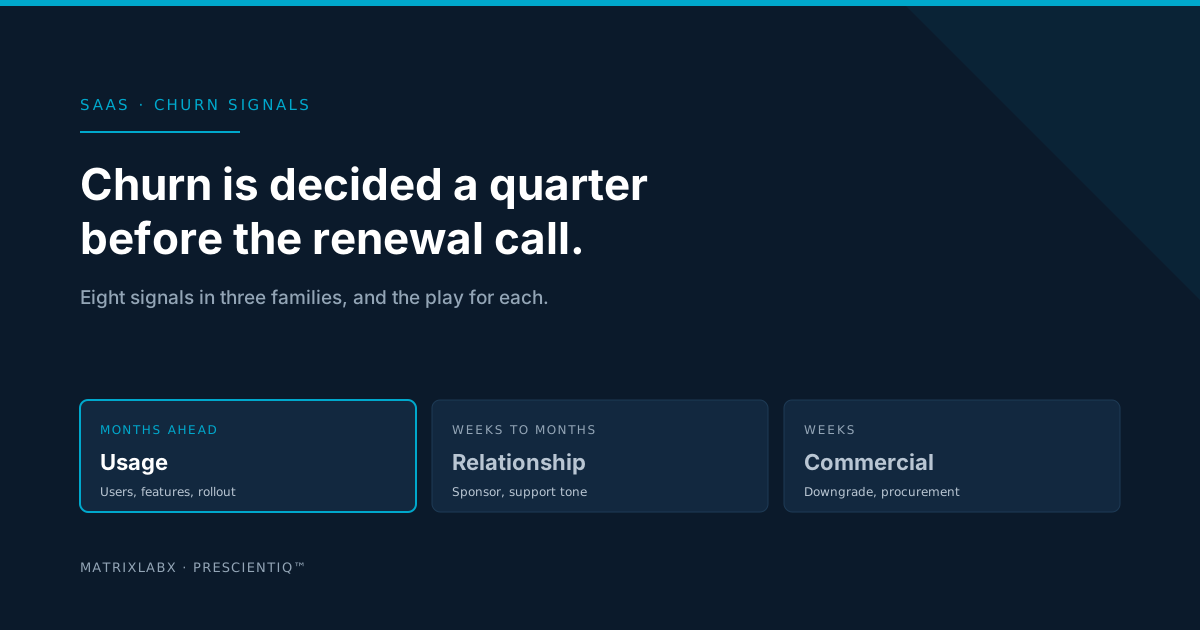
SaaS churn is decided well before the renewal call, and it leaves signals in three families. Usage signals (declining active users, narrowing feature use, a stalled rollout, a disconnected integration) move first, typically months ahead. Relationship signals (a sponsor change, a shift in support tone) follow. Commercial signals (a downgrade request, procurement contact) come last, with weeks left. Each calls for a different play.
Every churned account gets the same post-mortem. Someone pulls the usage chart, and there it is: the decline started two quarters ago. The data was collected the whole time. Nobody with a relationship to the account was looking at it weekly, and the health score that summarized it was read at a quarterly review, by which point the decision had been made.
This is the companion to the net revenue retention operating guide, which argues that retention is run weekly or discovered quarterly. This post is the list that weekly review needs: the eight signals worth watching, roughly how much warning each gives, and the specific play each one calls for.
The eight signals
Lead times are typical ranges for mid-market SaaS on annual contracts, stated in words on purpose. The honest number is the one you measure on your own churned accounts, and the last section shows how.
Active users decline
UsageTypical lead time: Months- What it looks like
- Fewer people logging in week over week, against the seats they pay for.
- The play
- Find the team that stopped and why. Re-activation aimed at that team, not a general check-in.
Feature use narrows
UsageTypical lead time: Months- What it looks like
- The account retreats to one or two features and stops using what justified the plan.
- The play
- Show the account what it stopped using and the outcome tied to it. If the feature no longer fits, right-size before renewal rather than at it.
Rollout stalls
UsageTypical lead time: Months- What it looks like
- The second team or region in the plan never onboards. Purchased seats stay unassigned.
- The play
- Treat it as an activation problem for the new team: a named owner on their side and a value event with a date.
Integration disconnected
UsageTypical lead time: Weeks to months- What it looks like
- A data source or downstream integration is removed or stops syncing.
- The play
- Ask what replaced it. A disconnected integration often means a competing tool is being trialed.
Sponsor change
RelationshipTypical lead time: Weeks to months- What it looks like
- The executive who bought leaves, changes role, or stops logging in.
- The play
- Build the relationship with the successor within weeks, with the value story rebuilt for their priorities.
Support tone shifts
RelationshipTypical lead time: Weeks to months- What it looks like
- Tickets move from how-to questions to complaints, or stop altogether in an account that used to ask.
- The play
- Escalate the pattern to product with the account named. Silence after a run of complaints is the louder signal.
Downgrade or seat-reduction request
CommercialTypical lead time: Weeks- What it looks like
- A request to shrink the plan mid-term or at renewal.
- The play
- Run a value review before quoting a price. A discount on a plan that is not being used delays the churn by one term.
Procurement or legal contact
CommercialTypical lead time: Weeks- What it looks like
- Questions about notice periods, data export, or contract terms from someone you have not dealt with.
- The play
- Assume an evaluation is under way. Get the business owner and your executive sponsor in the same conversation.
Why the health score is not enough
Most customer success teams already have a health score, and it is a reasonable summary. As a trigger it has three problems. It compresses eight signals into one number, so a sponsor change is averaged away by healthy logins. It hides which signal moved, which is exactly what determines the play. And it is read on the review cadence, not the signal’s cadence.
What the weekly review needs is the change rather than the snapshot: this account, this signal, this direction, this week, and the play that matches. That is a different artifact from a dashboard, and it is the one a customer success manager with forty accounts does not have time to build by hand.
Summary: signal families at a glance
| Family | Where it lives | Typical lead time | Who owns the response |
|---|---|---|---|
| Usage | Product analytics, data warehouse | Months | CSM, with product |
| Relationship | CRM contacts, support desk, login records | Weeks to months | CSM and an executive sponsor |
| Commercial | Email, billing, procurement portal | Weeks | Account lead, finance, executive sponsor |
A signal just moved. What now?
Pick an account whose signals changed this week and walk it through.
Which play does this account need?
Measure your own lead times
The ranges above are a starting point. The real ones are in your own history, and finding them is a small project. Take every account that churned or contracted in the last twelve months. For each, find the date its first signal moved and which signal it was. Subtract from the renewal date. You now have, for your product, which signal moves first and how much warning it gives, by segment. That table is worth more than any published benchmark, and it tells you which signals deserve a weekly review.
Where an agent fits
Reading eight signals across every account every week is exactly the work that does not get done by hand. Steward (PrescientIQ’s expansion agent) analyzes post-sale usage telemetry to flag cross-sell opportunities and surface churn-risk signals early, and prepares the play for the account owner between quarterly reviews, not at them. Account scoring runs on sandboxed deterministic code. No language model performs arithmetic that has a numeric consequence, so a score can be reproduced and checked. The decision about what to offer, whether to escalate, or whether to let an account go stays with your team, and any customer-facing message in the play is held for a named person’s approval. Every action, in either mode, is recorded to the audit ledger with its rationale, before-and-after state, and the approver or policy behind it.
It does not fix a product customers stop using, and it cannot read a signal you do not collect. For SaaS companies, how the platform maps to the whole funnel is on the PrescientIQ for SaaS page.
Frequently Asked Questions
- What are the early warning signs of SaaS churn?
- The earliest signs are in usage: declining active users, narrowing feature use, and a stalled rollout to new teams. Next come relationship signs: an executive sponsor who leaves or stops logging in, and support tickets shifting from how-to questions to complaints. Commercial signs, such as a downgrade request or procurement contact, come last.
- How far in advance can you see churn coming?
- Usage signals typically move months before a renewal date, relationship signals weeks to months, and commercial signals only weeks. The lead time depends on the product and contract length, so measure it on your own churned accounts: for each one, find when its signals first moved and how long before the renewal that was.
- Is a customer health score enough to predict churn?
- A health score is a useful summary but a poor trigger. It compresses several signals into one number, hides which one moved, and is usually read at a quarterly review. Churn work needs the change, not the snapshot: which signal moved, in which direction, when, and what play that calls for.
- Which churn signal matters most?
- The one that moves first in your product, which is usually a usage signal: fewer active users or narrower feature use. But the most dangerous is a sponsor change, because it can turn a healthy account in a single quarter with no usage decline to warn you. Watch usage weekly and sponsor changes continuously.
- What should you do when a churn signal fires?
- Match the play to the signal. A usage decline calls for a re-activation play aimed at the team that stopped. A sponsor change calls for a new executive relationship within weeks. A complaint pattern calls for escalation to product. A downgrade request calls for a value review, not a discount. Generic check-in emails fit none of them.
- Can AI agents detect churn signals?
- An agent can read usage for every account continuously, score a change, and prepare the matching play with its reasoning for the account owner. In PrescientIQ that is Steward’s job. The decision about what to offer or whether to escalate stays with your team, and any customer-facing message is held for a named person’s approval.
Related Reading
- Net Revenue Retention in SaaS: The Operating Guide (the pillar for this post)
- Inside Steward, PrescientIQ’s expansion and retention agent
- Inside Guide, PrescientIQ’s trial activation agent
- How governed expansion agents catch usage drop-offs in DevSecOps accounts
- How to Fix Revenue Leakage Between Marketing, Sales, and Customer Success
Notes on this post
The eight signals and their lead times are MatrixLabX’s working checklist for mid-market SaaS on annual contracts, stated as typical ranges, not measured statistics; measure your own as described above. No churn-rate, prediction-accuracy, or retention figure is stated, and no third-party statistic is quoted. Product statements match the current public copy.
See where your own execution effort is going
The Autonomous Audit Report models where your team's execution capacity is currently spent, what your configuration is actually paying for, and what the governed alternative looks like on your own data — before any commitment.
Get your free AAR benchmark