» Direct answer
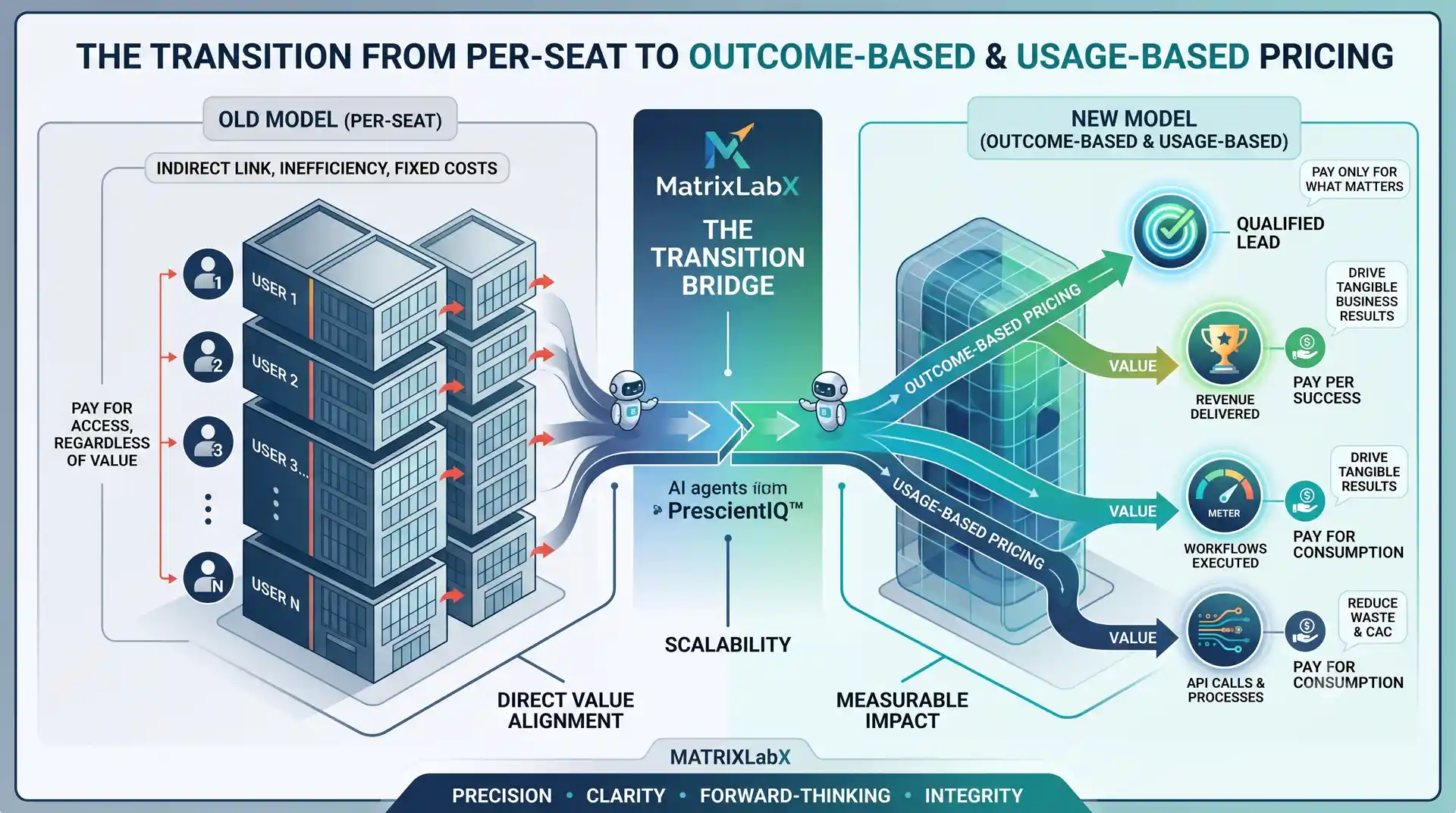
SaaS billing is moving from per-seat licenses to usage-based and outcome-based models because the two assumptions behind seats have failed: buyers no longer tolerate paying for licenses nobody uses, and AI features now complete work without a human at the keyboard — so a price anchored to human headcount shrinks exactly when the software delivers the most value. The replacements are metered usage (API calls, events), AI-credit packages, and outcome pricing tied to completed workflows.
Every seat-based renewal now triggers the same conversation. Procurement pulls the utilization report, finds that a third of the licenses haven't been logged into since onboarding, and asks the question no account executive wants: why are we paying for chairs?
For twenty years the per-seat subscription was the default because it was easy to sell, easy to forecast, and roughly correlated with value: more users meant more work done in the tool. Both halves of that bargain have collapsed. Enterprise buyers are auditing shelf-ware out of their budgets — and AI has severed the link between humans using software and work getting done. Industry monetization surveys now find a majority of SaaS companies actively rebuilding their pricing toward consumption-based or hybrid models.
This article maps the transition for the revenue leader who has to navigate it from either side of the table: why seats are dying, what is replacing them, why AI forces the issue, and what a trustworthy post-seat contract looks like — including how we price our own Revenue Accelerator agents, since we had to answer this question ourselves.
» Key takeaways
- Per-seat billing is in structural decline. Buyers audit utilization, refuse to renew shelf-ware, and a majority of SaaS vendors are rebuilding monetization toward consumption or hybrid models.
- AI makes seats self-defeating. When features automate the work, billing per human operator punishes the vendor for improving the product — and the buyer for adopting it.
- Three models are replacing seats: metered usage (API calls, events), AI-credit packages, and outcome pricing per completed workflow.
- The post-seat contract lives or dies on metering trust. Demand a verifiable usage ledger, committed pools with contracted overage, and invoices reconciled from the same data you can inspect.
Why is per-seat billing dying?
Because buyers finally measured what they were paying for. The per-seat model priced access, and for two decades access was a passable proxy for value. Then finance teams got utilization dashboards, and the proxy failed its audit.
Three pressures compounded:
- The shelf-ware reckoning. License-utilization audits routinely find 20–40% of paid seats inactive — bought during a growth spurt, kept through inertia, renewed by default. In a tighter budget era, every renewal now passes through a utilization review, and unused seats are the first line item cut.
- The seat is a bad unit of value. Two companies can pay for the same 50 seats while one runs its entire revenue motion through the tool and the other uses it as an address book. The invoice cannot tell the difference — which means the price never matched the value in either direction.
- Vendor economics turned adversarial. Seat models reward vendors for maximizing logins and headcount, not results. Buyers noticed that the metric their vendor optimizes — seats sold — is one they are actively trying to reduce.
The response is measurable across the industry: monetization surveys of SaaS operators show a clear majority now rebuilding pricing toward usage-based, outcome-aligned, or hybrid structures — not as experimentation at the margins, but as replatforming of the core model.
What is replacing seats? The three post-seat models
Metered usage, AI credits, and outcome pricing — usually in hybrid combinations. Each solves a different part of the seat problem, and each carries its own failure mode a buyer should price in.
Table 1 — The post-seat pricing landscape
| Model | What's metered | Aligns price with | Watch out for |
|---|
| Per-seat (legacy) | Human logins | ✕ Headcount, not value | Shelf-ware; punishes AI adoption |
| Usage-based | API calls, events, compute | ✓ Consumption | Bill anxiety; usage ≠ business result |
| AI credits | Model calls / agent runs via prepaid credits | ✓ AI work performed | Expiring credits; opaque burn rates |
| Outcome-based | Completed workflows / results | ✓ The business result itself | Requires trustworthy outcome metering |
Usage-based pricing meters inputs — dynamic API usage, records processed, compute consumed. It kills shelf-ware by construction (no usage, no bill) and is the natural fit for infrastructure and platform products. Its weakness is that usage is still an input: a million API calls that produce no business result still invoice.
AI-credit packages are the transitional model of the agentic era: prepaid units decremented as models and agents do work. Credits give the buyer a budgetable envelope and the vendor a hedge against variable inference costs. They inherit usage pricing's weakness plus two of their own — credits that expire unused recreate shelf-ware in a new costume, and opaque burn rates make invoices impossible to reconcile.
Outcome-based pricing is the destination: price anchored to the completed workflow or result the software was bought to produce — the resolved ticket, the qualified meeting, the executed campaign step. It is the hardest model to operate, because it demands something the other models don't: a metering record trustworthy enough that both sides accept it as the invoice's source of truth.
» Outcome pricing, operationalized
What does a post-seat contract look like in production?
PrescientIQ™ engagements bill a committed pool of completed, authorized workflows — metered on an immutable ledger your team can audit, with unlimited users, reviewers, and approvers. Headcount never changes the price. Only executed work does.
2 modes
human-in-the-loop or human-on-the-loop, set by your team
1 ledger
metering = invoice = audit trail
See the pricing model →
Why does AI force the transition?
Because AI's value proposition is fewer human operating hours — and seats bill per human operating hour. The better the AI, the fewer people need to touch the tool, and the smaller a seat-based invoice becomes. Per-seat pricing makes the vendor's best product improvements revenue-negative.
Play the incentive forward and it gets worse: a seat-priced vendor shipping powerful automation is financially motivated to keep humans in the workflow — to make the AI a copilot that assists seat-holders rather than an agent that replaces the busywork. The pricing model quietly shapes the product roadmap against the buyer's interest.
The labor math shows the stakes. A seven-person SDR team runs about $1.2M a year fully loaded and delivers roughly three-quarters of its theoretical capacity after ramp, vacancy, and turnover. When agents absorb that execution, the value delivered is measured in workflows completed — meetings sourced, records maintained, sequences executed — while the number of humans logging in drops. Any pricing anchored to the seats is anchored to the thing the technology is designed to reduce.
This is also why the metric conversation is changing on the buyer side. As we argued in Sales Process Coverage: the metric that replaces meetings booked, revenue teams are moving from counting human activity to measuring how much of the buyer's process the system can carry. Pricing follows measurement: revenue leaders are re-anchoring contracts on dynamic API usage, custom AI-credit packages, or — where the metering supports it — completed workflows.
"When midmarket enterprises embed AI into their core operations, they eliminate bureaucratic drag, allowing them to out-maneuver larger competitors who are constrained by legacy silos."
» George Schildge · CEO & Chief AI Officer, MatrixLabX
What should buyers demand from post-seat pricing?
Metering you can audit, commitments you can predict, and governance on every billable action. Usage and outcome models transfer pricing risk from "paying for nothing" to "paying for things you can't verify" — unless the contract closes that gap explicitly.
- A verifiable metering ledger. The invoice must reconcile from a usage record your team can independently inspect — not from the vendor's private analytics. If the metering system and the audit system are different systems, the invoice is an estimate.
- A precise billable unit. "Workflow" is marketing until the contract defines it. Insist on a unit definition that excludes drafts, retries, and failed runs — you should pay for completed work, not attempted work.
- Committed pools with contracted overage. Pure metered pricing creates bill anxiety; pure commitments recreate shelf-ware. The hybrid — a committed monthly pool sized to your volume, with a fixed overage rate and scheduled recalibration — gives finance predictability and operations headroom.
- Governance on every billable action. In agentic systems, the meter ticks when an agent acts. That makes approval gates a billing control, not just a safety control: an action a human approved is an action you agreed to pay for. As we detailed in Glass-Box Compliance, governance that sits on the execution path — screening before the act, logging immutably after — is what makes autonomous execution defensible. The same architecture is what makes autonomous billing defensible.
How does the Revenue Accelerator price completed workflows?
We had to answer this question ourselves, so here is the model in the open. The Revenue Accelerator Stack — Prospect. Engage. Convert. Expand. — is a PrescientIQ™ agent bundle that senses buying signals, decides the next-best action, and executes it across your CRM and outbound channels, with a human approving every action that leaves your building and an immutable record of why.
Four specialist agents, one governed loop: Scout (prospecting) qualifies accounts from intent and firmographic signals; Herald (outbound) drafts and — once a human approves — sends outreach; Guide (trial conversion) intervenes on stalling trials; Steward (expansion) surfaces upsell and churn-risk signals before your CSMs would notice. Marshal, the coordinator, orchestrates all four, and every externally visible action is written to an immutable audit ledger with its rationale and before/after state. It is built for CROs and RevOps teams at $20M–$500M ARR running Salesforce or HubSpot.
The pricing maps one-to-one onto this architecture:
Table 2 — Seat-model contract vs. Revenue Accelerator engagement
| Dimension | Per-seat SaaS | Revenue Accelerator (outcome-based) |
|---|
| Billable unit | A login, used or not | A completed, authorized consequential action |
| Drafts, retries, rejections | n/a — everything is a seat | ✓ Never billed |
| Adding users/approvers | ✕ Price increases | ✓ Unlimited — headcount never changes price |
| Volume structure | Seat tiers | Committed monthly pool + contracted overage |
| Invoice source | Vendor's records | The same immutable ledger your team audits |
| Shelf-ware risk | ✕ Structural | ✓ No usage → pool recalibrates |
» BILLING_RECONCILIATION — revenue_accelerator# month-end: invoice computed from execution ledger...
» prospecting 412 accounts qualified POOL ●
» outbound 1,847 approved sends POOL ●
» trial_conversion 96 interventions executed POOL ●
» expansion 38 signals surfaced → actioned POOL ●
» drafts_rejected 214 drafts not approved NOT BILLED
# every line traceable to ledger entries w/ rationale + before/after state
INVOICE = f(ledger) — no estimates, no seat count anywhere
The full rate card — implementation, annual platform, and how the committed pool is sized against your own CRM volumes — is public on the pricing page.
» Canonical definition
MatrixLabX replaces your fragmented SaaS stack with an autonomous digital workforce. We shift your business from Software as a Service to Labor as a Service. Our agents don't wait for prompts — they sense, decide, act, and learn 24/7 to deliver measurable P&L impact within 60 days.
Go deeper on the economics and the architecture behind post-seat pricing:
Where per-seat pricing still makes sense
Honesty about the counter-case: seats remain a reasonable model for tools with uniform, daily, human-centric use — email, calendars, design suites — where every licensed user genuinely operates the product and value really does scale with people. Usage and outcome models also carry real costs of their own: metered bills are harder to forecast, outcome attribution can turn into a negotiation if the billable unit is sloppily defined, and credit systems can recreate shelf-ware through expiry. The transition is not "seats bad, meters good." It is: price the thing the buyer actually values, and make the meter auditable. For human-operated tools that may still be a seat. For AI that executes work, it almost never is.
People also ask
Why is per-seat pricing declining?
Two forces. Buyers are auditing license utilization and refusing to renew shelf-ware — seats paid for but never logged into. And AI features now complete work that used to require human operators, so a price anchored to human headcount shrinks precisely when the software delivers the most value. Industry monetization surveys show a majority of SaaS companies rebuilding their pricing toward consumption-based or hybrid models in response.
What is outcome-based pricing in SaaS?
Pricing anchored to completed results rather than access or activity: a resolved support ticket, a qualified meeting, a completed workflow. The vendor is paid when the work the software was bought to do actually happens. It requires trustworthy metering — a verifiable record of each outcome — which is why audit-ledger architectures matter to the model.
What is the difference between usage-based and outcome-based pricing?
Usage-based pricing meters inputs and activity — API calls, events processed, compute consumed, credits burned. Outcome-based pricing meters results — workflows completed, tickets resolved, pipeline created. Usage models align price with consumption; outcome models align price with the business result. Hybrids are common: a committed platform fee plus metered usage, with outcome benchmarks in the contract.
Why does AI break per-seat pricing?
Per-seat pricing bills per human operator. AI's whole promise is fewer human operating hours per unit of output — agents research, draft, execute, and reconcile without a person at the keyboard. Under seats, better AI means fewer seats means less vendor revenue, so the vendor is financially punished for making the product more autonomous. Revenue leaders resolve the conflict by pricing dynamic API usage, AI-credit packages, or completed workflows instead.
What are AI credits in software pricing?
Prepaid units that meter AI consumption — model calls, agent runs, or task executions — decremented as the AI does work. Credits give buyers a budgetable envelope and vendors a margin hedge against variable inference costs. The risks to watch: expiring credits (paying for capacity you never used) and opaque burn rates that make invoices impossible to reconcile.
How does the PrescientIQ Revenue Accelerator price its agents?
Not per seat. The billable unit is a completed, authorized consequential action, such as an outbound send, a CRM write, or an executed workflow step. The annual engagement includes a committed monthly pool of executed workflows, and every invoice reconciles from the platform's own audit ledger. Users, reviewers, and approvers are unlimited, so headcount never changes the price.
» Free engagement · 24-hour response
Stop paying for chairs. Start paying for outcomes.
The free AAR Benchmark models what your revenue motion costs under seats, agencies, and headcount today — and what the same output costs when governed agents execute it, priced per completed workflow.
Book a Discovery Call →
» Deployment in 21 days or less · P&L impact within 60 days · matrixlabx.com/contact