Buyer intelligence vs. decision intelligence: what each does at every stage of the SaaS buying cycle
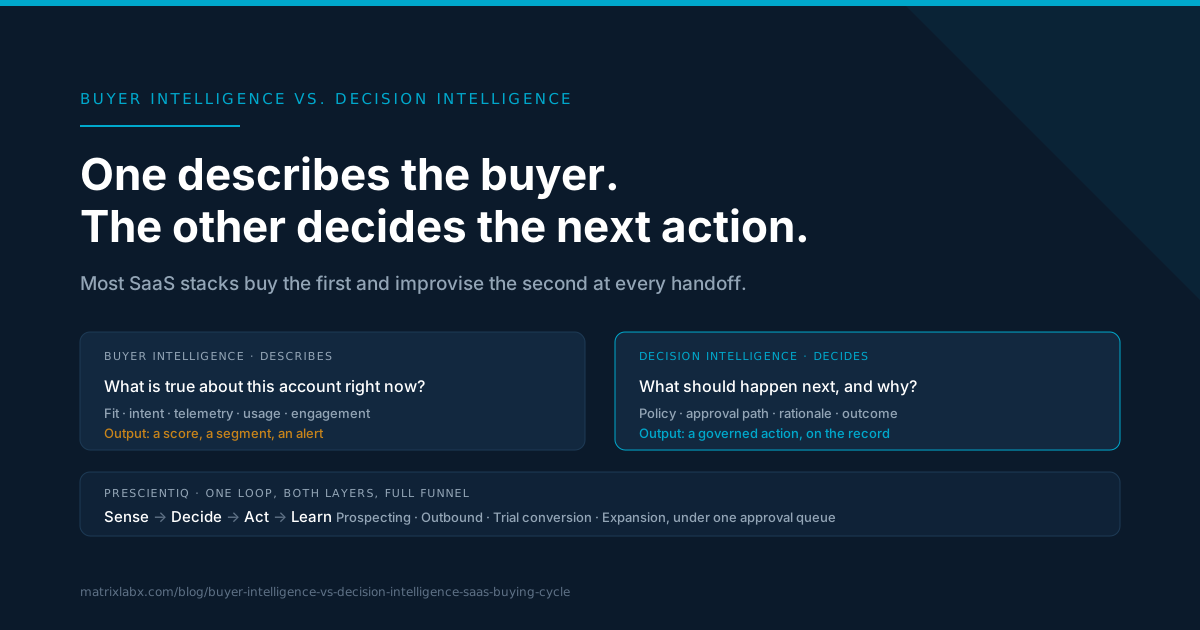
Buyer intelligence tells you what is true about an account: who they are, what they are doing, how well they fit. Decision intelligence decides what to do about it, under policy, with a named approver, and learns from the result. Most SaaS revenue stacks buy a great deal of the first and improvise the second at every handoff. PrescientIQ runs both through one Sense, Decide, Act, Learn loop from prospecting to expansion.
Every mid-market SaaS revenue team we talk to knows more about its buyers than it did three years ago. Intent data, product telemetry, enrichment, engagement scoring, and a CRM that finally has most of the fields filled in. The dashboards are better. The alerts are more frequent. And the same complaint keeps surfacing in different words: we can see it, but nothing happens fast enough.
That complaint is not a data problem. It is the sound of a stack that has invested heavily in one kind of intelligence and almost nothing in the other. This post draws the line between the two, walks the SaaS buying cycle stage by stage to show where each one does its work, and then lays out the full-funnel framework PrescientIQ uses to run both as one loop. If you are evaluating where AI agents belong in your revenue motion, the distinction is the whole decision.
Two kinds of intelligence, one confused budget
Buyer intelligence is everything you can know about an account and the people in it. Firmographics and technographics. Intent topics surging on third-party networks. Visits to your pricing page. Which activation milestones a trial has reached. Usage against a plan limit. It is descriptive: its job is to tell you the state of the world with as little lag as possible. Its natural output is a profile, a score, a segment, or an alert.
Decision intelligence is what turns that state into a governed next action. Given what is true about the account, what should happen, why, who needs to approve it, and what did the last similar action teach us? It is prescriptive and accountable: its natural output is a decision with a rationale attached, a confidence, an approval path, and a record that survives the quarter.
The two are not competitors and one does not replace the other. Decision intelligence with no buyer intelligence underneath it is guessing with good posture. Buyer intelligence with no decision layer on top is the situation most teams are actually in: a rich picture of the buyer, and a human at every stage who has to notice it, interpret it, decide, act, and remember to write it down.
| Dimension | Buyer intelligence | Decision intelligence |
|---|---|---|
| The question it answers | What is true about this account right now? | What should happen next, and why? |
| Typical inputs | Firmographics, technographics, intent topics, web and product telemetry, CRM history, engagement | Buyer intelligence plus policy, pipeline state, prior outcomes, capacity, and the approval chain |
| Output | A profile, a score, a segment, an alert | A proposed action with a rationale, a confidence, an approval path, and a record |
| Unit of value | Coverage: how much of the market you can see | Executed outcomes: how many signals became a governed action in time |
| Who consumes it | A rep or marketer reading a dashboard or an alert | An execution layer that acts, and an approver who authorizes |
| Failure mode | Stale or wrong: the score moved and nobody knows why | Slow or unowned: everyone saw the signal, nobody decided, nothing was recorded |
Why the SaaS buying cycle makes the gap expensive
A SaaS buying cycle is not a straight line from lead to close. It runs through a trial or a proof, into onboarding, and then into an expansion and renewal motion that can be worth more than the original deal. Each of those stages produces its own buyer intelligence, often in a different system owned by a different team: intent data in marketing, deal stages in sales, product events in product analytics, usage and health in customer success.
The decision layer, meanwhile, is a person at each seam. Marketing decides which surges to route. An SDR decides which alert to work first. An AE decides when a stalled deal needs a nudge. A CSM decides whether a usage dip is noise. None of those decisions are wrong in isolation. The problem is that they are made late, made inconsistently, and almost never recorded with the reasoning that produced them. That is why the same signal can be handled three different ways in the same quarter, and why nobody can say which way worked. We covered the structural side of this in how revenue leaks between marketing, sales, and customer success; the short version is that revenue leaks at the handoffs, and the handoffs are exactly where decision intelligence is missing.
Stage by stage: what each layer contributes
The table below walks six stages of a typical mid-market SaaS buying cycle. For each one it lists the buyer intelligence that is usually available, the decision that actually needs to be made, and what goes wrong when the decision is left to whoever notices.
- Buyer intelligence available
- Intent topics spike, a leadership change lands, a stack change shows up in technographics. Fit and timing signals arrive here first.
- Decision that needs making
- Is this account inside the ideal customer profile, is it already in an open opportunity, and is the trigger strong enough to justify a first touch this week?
- What happens without a decision layer
- Surges get worked in the order reps notice them, not in the order they matter.
- Buyer intelligence available
- Content consumption, pricing-page visits, comparison searches, multiple contacts from one domain.
- Decision that needs making
- Which message fits the trigger that fired, which contact should receive it, and does it need a second approver because it names a competitor or a price?
- What happens without a decision layer
- Outreach is generic because nobody wrote the rule that connects a specific signal to a specific message.
- Buyer intelligence available
- In-product events: activation milestones reached or missed, seats invited, integrations connected, days since last login.
- Decision that needs making
- Has this trial stalled before its value event, and which activation sequence should fire now rather than at the end of the trial?
- What happens without a decision layer
- The stall is visible in a product dashboard and acted on at the exit survey.
- Buyer intelligence available
- Deal stage, stakeholder map, security questionnaire status, procurement signals.
- Decision that needs making
- Which stalled deal gets an intervention, with what material, and who owns the follow-up so the AE is not rebuilding context from a CRM note?
- What happens without a decision layer
- Stalled deals are found in the pipeline review, weeks after the stall.
- Buyer intelligence available
- Time to first value, admin setup completion, support ticket patterns, adoption by team.
- Decision that needs making
- Which accounts are drifting from the activation path, and what the CSM should be handed before the first check-in rather than after it?
- What happens without a decision layer
- Activation risk is a lagging metric on a QBR slide.
- Buyer intelligence available
- Usage against plan limits, new teams adopting, feature depth, executive sponsor changes, declining logins.
- Decision that needs making
- Is this an upsell moment or a churn pattern, how far ahead of the renewal should someone act, and what case should be pre-built for the account owner?
- What happens without a decision layer
- Expansion waits for the renewal date; churn is discovered at the renewal date.
Read down the right-hand column and a pattern shows up. Buyer intelligence is strongest at the top of the funnel, where intent and fit data are abundant and the tooling is mature. The costly gaps are mid-funnel and post-sale, where the signal is a product event or a usage trend, the window to act is days, and the person who would act is a CSM or an AE with forty other accounts. That is the same conclusion we reached from a different direction in Beyond Top-of-Funnel: a full pipeline and a leaking one look identical from the top.
What most revenue stacks actually buy
Walk through a typical mid-market SaaS stack by tool class and the imbalance is stark.
- Data and intent providers are pure buyer intelligence. They tell you who is in-market and who fits. They make no decision.
- CRM and RevOps platforms record and analyze. They hold the buyer intelligence in one place and report on it. The decision is still a human reading a view.
- Sales engagement tools help a person execute a decision they already made: the sequence runs once a rep enrolls the contact. Enrollment is the decision, and it is manual.
- Copilots draft on request. They raise the ceiling on an hour of work but do not decide when the hour should be spent.
- Ungoverned autonomous agents make decisions, which is the point, but without a policy layer, an approval gate, or a ledger. You find out what was decided when a prospect replies to it.
The first four are buyer intelligence, or tools for humans to act on buyer intelligence. Only the last one is a decision layer, and it is a decision layer with the accountability removed. We compared those categories on what they do, who operates them, and their unit of value in RevOps platform vs. sales engagement tool vs. AI revenue agent. The missing category is the one that makes decisions and stays accountable for them.
PrescientIQ’s full-funnel framework: one loop, both layers
PrescientIQ is built on the premise that buyer intelligence and decision intelligence are two phases of the same cycle, not two products. The platform runs a continuous loop with four phases: Sense, Decide, Act, and Learn. Four cooperating agents sit inside that loop under one coordinator, Marshal, covering prospecting, outbound, trial conversion, and expansion, so the same loop runs from the first intent surge to the renewal.
Scout
Continuously ingests CRM records, intent signals, web telemetry, and product usage, and identifies ICP-fit accounts. Scoring is deterministic: identical inputs always produce identical scores, so a score that moved can always be explained.
Marshal and the policy layer
Turns a signal into a proposed action with a rationale, checks it against the standing policy your team set for that action class, and routes anything externally visible to a named approver.
Herald and Guide
Outbound drafts outreach grounded in the exact trigger that fired and holds it for approval. Trial Conversion monitors in-product events and fires activation sequences at the moment a trial stalls before the value event.
Steward and the audit ledger
Expansion surfaces upsell and churn-risk signals from account behavior before a CSM would catch them. Every executed action, its rationale, and its outcome are written to the ledger, so the next Sense cycle begins with what actually worked.
Sense: buyer intelligence, ingested continuously
The loop starts where every stack already has data. CRM records, buyer-intent signals, web telemetry, and in-product usage are ingested as they happen rather than exported into a weekly list. Scout (PrescientIQ’s prospecting agent) identifies ICP-fit accounts from intent and firmographic signals. Its scoring is deterministic application logic, not model judgment: identical inputs always produce identical scores. That matters for the decision layer above it, because a score that moved can always be explained, and a decision built on an explainable score can be defended to the approver who has to sign it. How that scoring hands off is covered in Scout explainer.
Decide: the decision-intelligence layer, made explicit
This is the phase most stacks do not have. Marshal takes a signal and produces a proposed action with a rationale attached: which account, which contact, which message class, which trigger justifies it, and how confident the system is. It then checks that proposal against the standing policy your team set for the action class. Some actions are permitted to proceed inside policy. Anything externally visible, such as an email, a sequence enrollment, or a CRM change a customer would see, is routed to a named human for approval before it executes.
That gate is not a setting. It is the default, and there is no autonomous send path in the product. The reason is the one this post is about: decision intelligence without accountability is just faster guessing. The approver sees the signal, the proposed action, and the reasoning together, which is a fundamentally different review from an alert that says an account surged. We wrote up why buyers moved back to this model in Governed Autonomy.
Act: execution grounded in the trigger
Once approved, the action executes. Herald (PrescientIQ’s outbound agent) drafts outreach grounded in the exact trigger signal that fired, so the message carries the buyer intelligence that produced it rather than a template with a merge field. Mid-funnel, Guide (PrescientIQ’s trial conversion agent) monitors in-product events and fires an activation sequence at the moment a trial stalls before its value event, which is the stage-three decision in the table above being made in hours instead of at the exit survey. Herald’s approval mechanics are detailed in its own explainer.
Learn: the outcome becomes next cycle’s context
Every executed action is written to an audit ledger with its rationale, the policy it ran under, and its outcome. Post-sale, Steward (PrescientIQ’s expansion agent) surfaces upsell and churn-risk signals from account behavior before a CSM would catch them, and those outcomes feed back too. This is what separates a loop from a pipeline. A pipeline of point tools re-discovers the account at every stage with a cold start. A loop hands the next phase the history intact, so the decision layer is working from what actually happened last time, not from a fresh score.
Where the data runs
PrescientIQ is hosted and operated by MatrixLabX on Google Cloud. SOC 2, ISO 27001, and PCI DSS attestations are held by Google Cloud, which operates the underlying infrastructure. They are not MatrixLabX certifications. MatrixLabX application-layer SOC 2 is in progress.
Which gap do you actually have?
Before adding any tool, it is worth knowing which layer is missing. Think about the last account signal that mattered to you this quarter, and answer the four questions below honestly.
Is your gap buyer intelligence or decision intelligence?
What this framework does not claim
Decision intelligence does not make the judgment calls disappear. Someone still owns what “good” looks like at each stage, writes the policy for each action class, and approves what goes out. The loop makes those judgments explicit, fast, and recorded; it does not remove them. It also does not repair bad buyer intelligence. A stale CRM or an intent feed full of noise produces confident proposals on wrong inputs, which is why the readiness audit starts with your data before it models anything. And it is not a promise about outcomes at your company: MatrixLabX is available through a founding pilot program, and every engagement begins with a free Autonomous Audit Report modeled on your own numbers before any commitment.
Frequently Asked Questions
- What is the difference between buyer intelligence and decision intelligence?
- Buyer intelligence describes the state of an account: who they are, what they are doing, and how well they fit. Its output is a profile or a score. Decision intelligence takes that state and produces a governed next action: what to do, why, whether it needs approval, and what the outcome taught the system. Its output is a decision with a rationale and a record.
- Is intent data the same thing as decision intelligence?
- No. Intent data is buyer intelligence: a signal that an account is researching a topic. It says nothing about whether outreach is the right move, which message fits the trigger, whether the account is already in an open opportunity, or who should approve the send. Turning the signal into that governed action is the decision-intelligence layer most stacks leave to whichever rep sees the alert first.
- Where does decision intelligence matter most in the SaaS buying cycle?
- At the handoffs. Buyer intelligence is usually strongest at the top of the funnel, where intent and firmographic data are plentiful. The costly gaps are mid-funnel and post-sale: a trial stalling before its value event, or usage drifting toward a plan limit or a churn pattern. Those moments need a decision within days, and a dashboard alone does not make one.
- How does PrescientIQ combine the two?
- Through one continuous loop. Sense ingests buyer intelligence from CRM, intent, web telemetry, and product usage. Decide scores deterministically where the input is numeric and routes each proposed action through policy. Act executes only after a named human approves anything externally visible. Learn writes the outcome back so the next cycle starts with more context, not a cold start.
- Does decision intelligence mean the AI decides without a human?
- Not in PrescientIQ. Every externally visible action, such as an email, a sequence enrollment, or a CRM change a customer would see, requires a named human approval before it executes, and every action is written to an audit ledger with its rationale. Decision intelligence proposes and governs the decision; it does not remove the approver.
- How do I tell which layer my own revenue stack is missing?
- Ask four questions about your last important account signal. Did you know why the score moved? Did someone decide what to do within a day? Was that decision recorded with its reasoning? Did the outcome change how the next signal is handled? A "no" on the first is a buyer-intelligence gap. A "no" on any of the other three is a decision-intelligence gap.
Related Reading
- How to Define a B2B Ideal Customer Profile From Your Own Closed Deals
- The Agentic Era of GTM: From Fragmented Handoffs to Hands-Off Outcomes
- The Agentic GTM Fit Curve: Where Digital Labor Takes Over and Where Sellers Still Win
- The Foundation for Digital Labor: Context, Governance, and Outcomes Over Model Benchmarks
- Beyond Top-of-Funnel: How Full Revenue Loop Digital Labor Drives Mid-Market SaaS Growth
- RevOps Platform vs. Sales Engagement Tool vs. AI Revenue Agent
- Governed AI SDR: Definition, How It Works, and How It Is Priced
Notes on this post
“Buyer intelligence” and “decision intelligence” are used here as working definitions for revenue practitioners, not as any analyst firm’s category labels. The stage table describes typical mid-market SaaS motions and is illustrative; your cycle may have more or fewer stages. Agent descriptions match the current public product copy. The one figure on this page renders from the site’s governed claims register with its proof class shown. No comparative performance claim is made about any named vendor or product.
See where your own execution effort is going
The Autonomous Audit Report models where your team's execution capacity is currently spent, what your configuration is actually paying for, and what the governed alternative looks like on your own data — before any commitment.
Get your free AAR benchmark