Inside Scout: how it finds, scores, and hands off accounts
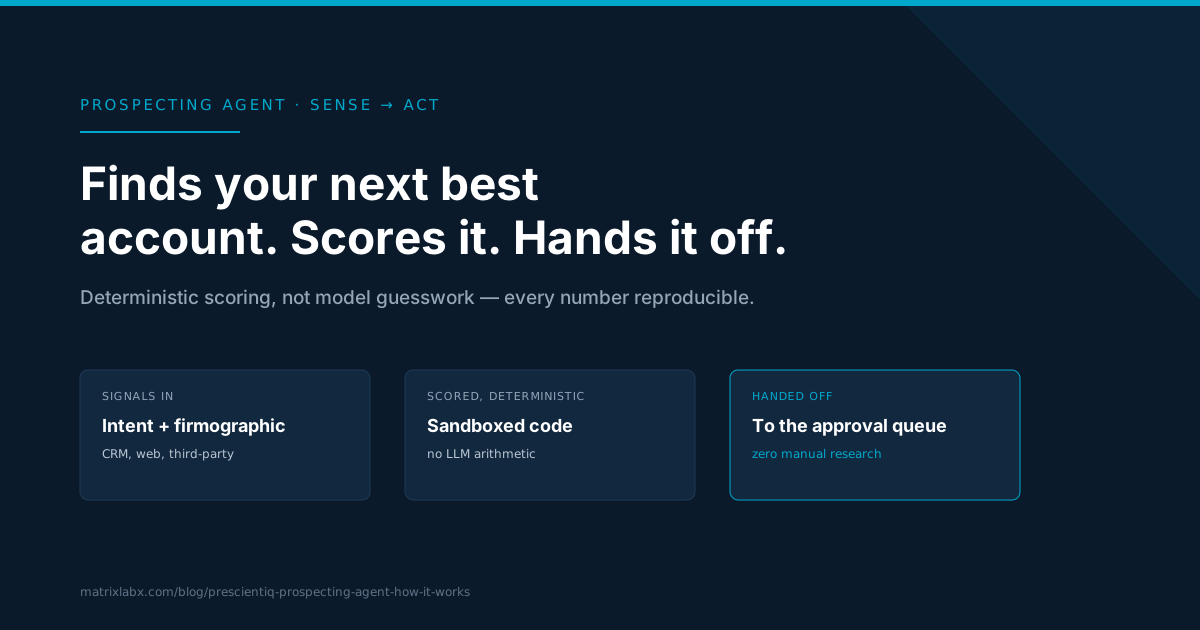
Scout replaces a target list that goes stale the week it is built with one that never stops updating. It continuously scores accounts against live signals, deterministically, and hands qualified ones to a governed outbound queue— zero manual research, and no send happens without a named person’s approval.
Most target lists are built once and worked until they run out. In between refreshes, accounts that just showed real buying intent sit alongside accounts that went cold months ago, indistinguishable on the list a rep opens Monday morning. A commonly cited industry range puts CRM record decay at up to roughly 30% within a year — enough stale data that reps lose real selling time to manual list hygiene before they ever open a sequence tool. Separately, a human SDR working that list by hand tops out at somewhere around 40 to 60 genuinely personalized touches a day, regardless of how good the list is.
Scout is built against both constraints at once: it removes the staleness problem by scoring continuously instead of periodically, and it removes the research bottleneck by handing a rep a ranked, qualified account instead of a name and a company domain.
What it actually does
On our own pricing page, this is described in one sentence: it “identifies ICP-fit accounts from intent and firmographic signals with deterministic, sandboxed scoring — no LLM arithmetic on anything with a numeric consequence.” Unpacked, that is three distinct steps running continuously rather than on a schedule.
First, it ingests signals — CRM activity, firmographic data, and whatever intent sources you already license — rather than waiting for someone to pull a report. Second, it scores each account against your ideal customer profile using sandboxed, deterministic code, not a language model’s best guess at a number. Third, it hands qualified accounts to Herald’s approval queue with no manual research step in between.
Why the scoring is deterministic, not model-generated
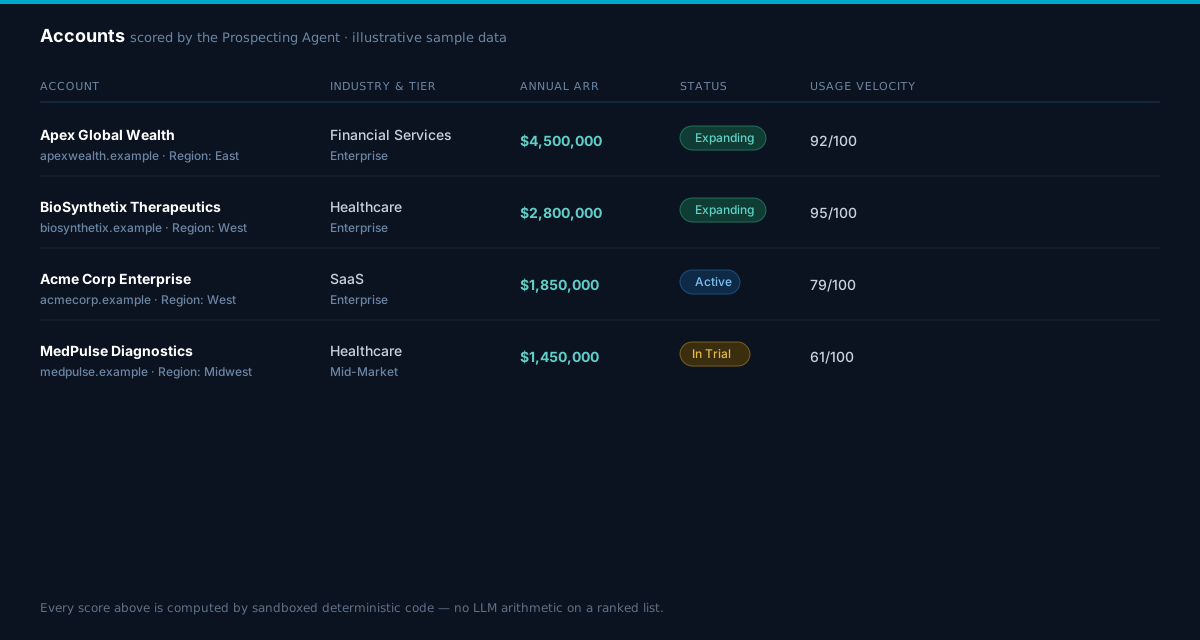
It is tempting to let a language model produce a priority score directly — it is fast, and the output looks plausible. The problem is that “plausible” and “reproducible” are different properties, and a score a rep is going to act on needs the second one. Two identical accounts scored a week apart should get the identical number, and if a score looks wrong, someone needs to be able to trace exactly why it came out that way.
That is why any calculation with a numeric consequence — a rank, a priority, a threshold that decides whether an account gets worked today — runs through sandboxed deterministic code instead of being asked of the model. The model still does the language-heavy work upstream (interpreting signals, adding context); the arithmetic that decides what a rep sees first does not touch it.
What a rep actually sees, day to day
In practice this collapses the first hour of a rep’s morning into nothing. Instead of opening five tabs — the CRM, an intent platform, a firmographic lookup, a LinkedIn search, and a spreadsheet someone half-maintains — a rep opens one list, already ranked, with the signal that earned each account its position attached to the row. An account that just showed a real trigger — a leadership change, a technology-stack update, a spike in product-page visits — shows up at the top with that trigger named, not buried in a separate tool a rep has to remember to check.
What does not change is who decides an account is worth working. The agent surfaces the ranking and the reason behind it; a rep or their manager still sets the bar for what “qualified enough” means for their own territory, and can override the agent’s ranking at any time. Scoring removes the research tax, not the judgment call at the end of it.
From scored account to working pipeline
A qualified account does not sit in a report waiting to be noticed — it moves. The hand-off to Herald happens without a manual step, and from there the account progresses through a normal pipeline, with each stage change and every AI-assisted read on sentiment logged as it happens rather than summarized after the fact.
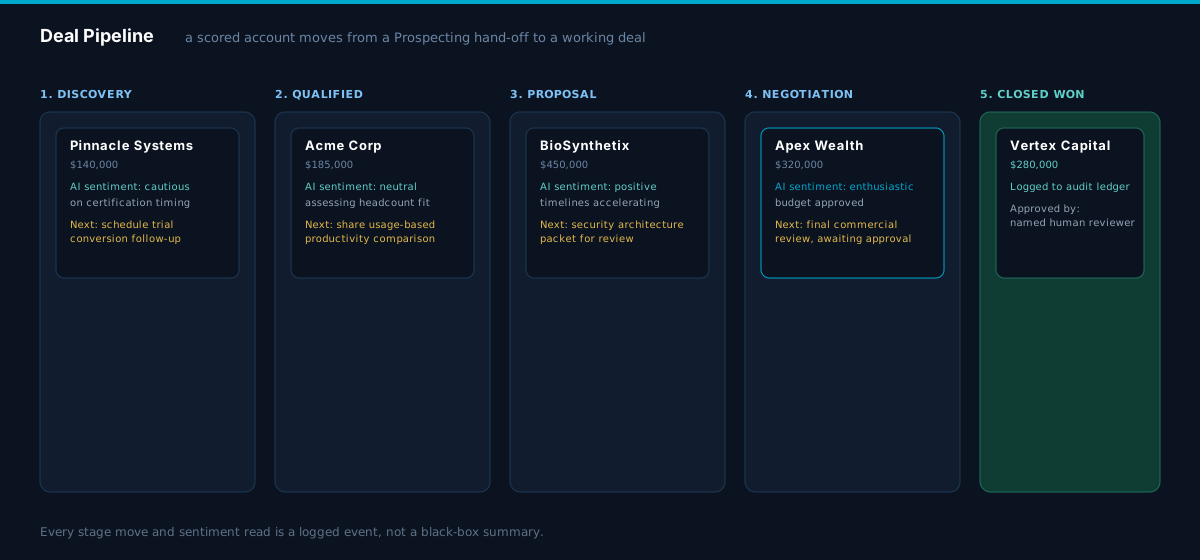
Nothing external leaves on the strength of Scout’s score alone. Every draft Herald produces from a qualified account waits for a named person to approve it.
What else the platform surfaces once you are talking
Once a qualified account turns into an active conversation, the same governed approach extends past prospecting. A call or demo recording gets parsed into structured decisions and action items instead of relying on someone’s notes — a downstream convenience, not something Scout itself performs.
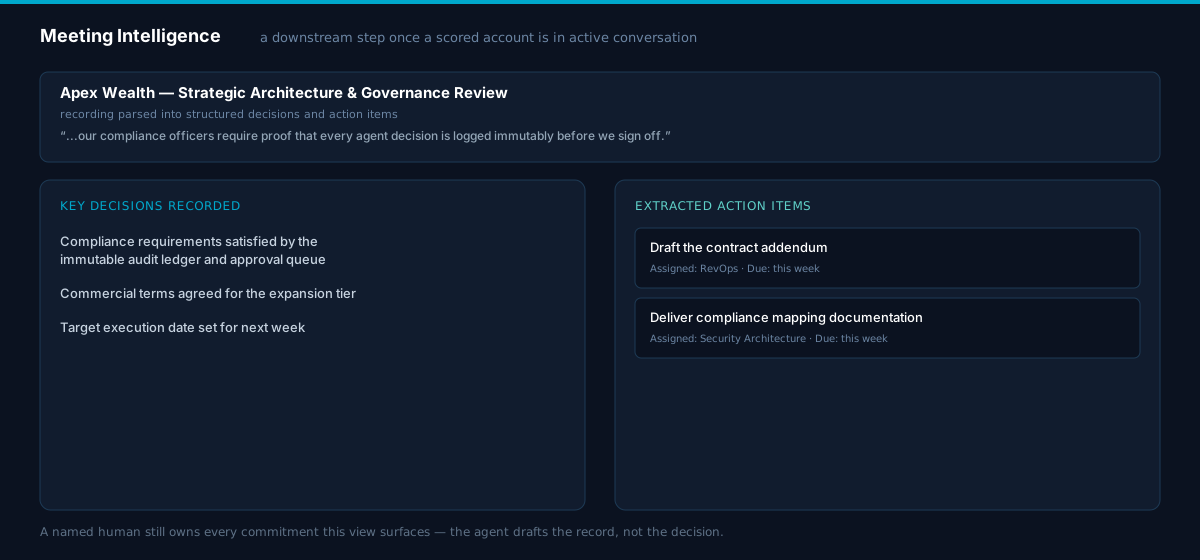
A named human still owns every commitment that view surfaces — the agent drafts the record, not the decision. That distinction holds everywhere in the platform, which is the point of the next section.
Every action, logged before it is trusted
A score, a stage change, an approval, a rejection — each is written to an append-only ledger with the actor, the confidence, and the rationale at the moment it happens, not reconstructed from application logs afterward if someone asks.
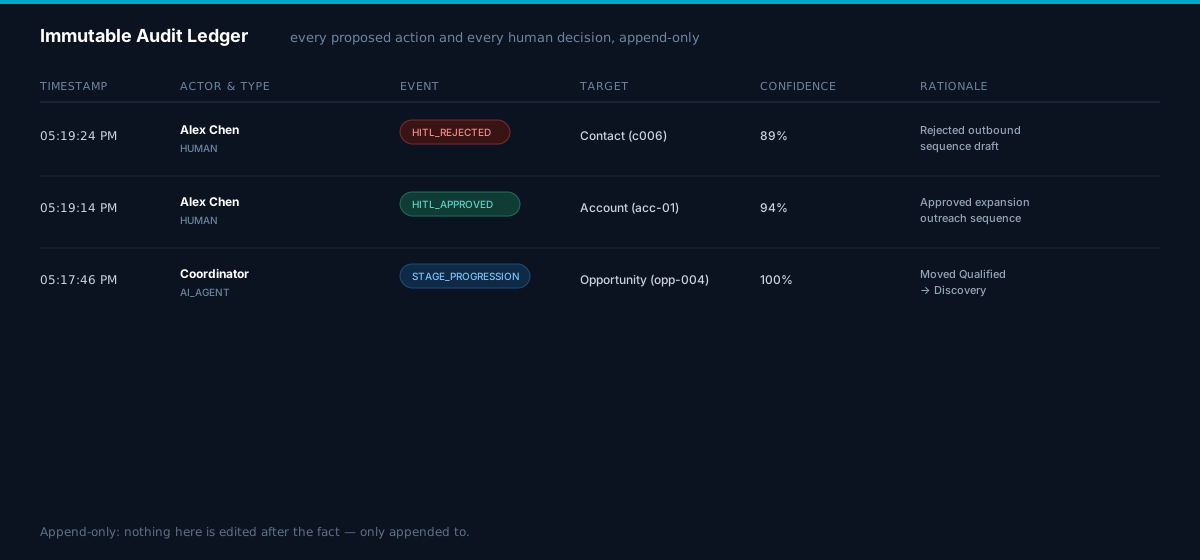
That is also what a security review is actually checking for when it asks about an AI tool’s audit trail — not whether the product can produce a summary on request, but whether the record existed before anyone asked. We cover what a review checks in full in a dedicated checklist.
Where it fits, and what it does not do on its own
Scout is one stage of a longer loop, not the whole motion. It does not draft or send outbound — that is Herald’s job, gated by approval. It does not manage a trial once an account converts, and it does not surface expansion signals on an existing customer — those belong to later stages of the same coordinated loop, covered in a companion post on full revenue loop coverage. And it inherits whatever your CRM data already is — Scout scoring against inconsistent or duplicate records will surface that inconsistency faster, not fix it silently. We cover that specific failure mode in a deeper look at CRM data debt.
A typical deployment timeline, subject to your own CRM’s data quality and integration scope.
Where the data runs
The answer, stated plainly:
PrescientIQ is hosted and operated by MatrixLabX on Google Cloud. SOC 2, ISO 27001, and PCI DSS attestations are held by Google Cloud, which operates the underlying infrastructure. They are not MatrixLabX certifications. MatrixLabX application-layer SOC 2 is in progress.
What it costs
Scout ships as one line of the full Revenue Accelerator platform fee — on our pricing page it is listed as “Scout · Pipeline Research Analyst,” alongside Herald, Guide (trial conversion), and Steward (expansion), under one published rate:
| Component | Investment | Billing frequency |
|---|---|---|
| Annual platform feeEnvironment provisioning on Google Cloud, per-agent IAM, audit-ledger setup, and context ingestion from your CRM — plus four cooperating agents (Scout, Herald, Guide, and Steward), their coordinator Marshal, the approval queue and standing-policy controls, and the immutable audit ledger, and the monthly execution volume a typical mid-market deployment runs. One fee, from signature, every year.Target — modeled: live in 21 days or less$165,000/year is the complete platform fee. There is no separate implementation charge and no different first-year number — deployment work is included from signature, not billed as a distinct line. Scope beyond a typical deployment — additional bundles, sustained higher volume — is quoted at your AAR before anything is signed. | $165,000/yr | Billed monthly at $13,750/mo against an annual commitment |
How that compares to what you are paying now
A platform fee only means something next to whatever is currently doing this work. For most mid-market teams that is one of two things: an agency retainer, or an in-house SDR pod. Both comparisons below are cost-structure comparisons only. Neither claims that one agent produces the output of a given number of people — that is a measurement we do not have and will not assert. What is comparable is what each model charges for, what it includes, and how the cost behaves when volume changes.
1. Against a mid-market agency retainer
An outbound agency sells the same function this agent performs: somebody else finds and prioritises the accounts. Retainers for that coverage commonly run somewhere between $60,000 and $300,000 a year in the mid-market, scoped by team size and channel mix — a general range worth using to sanity-check a quote rather than a number for any specific firm.
| Cost component | Agency retainer | Scout |
|---|---|---|
| Headline cost | Roughly $60,000–$300,000/yr, scoped by team size and channel mix | One published platform fee covering all four agents, not a per-function line |
| What the fee buys | A team's time, scoped by the hours or seats written into the contract | Execution capacity priced by the platform rather than the roster assigned to you |
| Ramp | Weeks to months per assigned rep, and it resets when the account team changes | No ramp — scoring runs from deployment |
| List freshness | Refreshed on the agency's cadence, commonly monthly or quarterly | Continuous — accounts are re-scored as signals change |
| Scoring transparency | You see the output; the prioritisation logic belongs to the agency | Deterministic and reproducible, logged with the signal behind each score |
| Scope | Usually prospecting and outbound; later stages are a separate contract | Hands into outbound, trial conversion, and expansion in the same loop |
What a retainer buys that this does not: human judgment on genuinely ambiguous accounts, a named strategist a prospect can be escalated to, and the ability to redirect effort mid-quarter with a phone call rather than a configuration change. Those are real, and a platform priced on execution does not replace them by default. The full version of this math is in our agency-retainer cost comparison.
2. Against a seven-person SDR pod
The in-house comparison is harder, because the number most teams carry in their head is the base-salary line rather than the run rate. For a seven-rep pod — the standard shape, since seven is about one manager’s span of control — the published model looks like this:
| Line | Annual cost | What it covers |
|---|---|---|
| Base-salary budget line | $434,000 | The number that appears in the plan — roughly a third of the real run rate |
| Seven reps, fully loaded | $889,000 | ~$127,000 each once variable comp, payroll tax, benefits, and ramp drag are counted |
| One dedicated manager | $205,000 | Seven reps is one manager's span of control; without it there is no coaching or pipeline inspection |
| Tech stack, five categories × 7 seats | $108,000 | Sourcing, enrichment, sequencing, dialing, and intent tooling |
| Total annual run rate | ≈ $1,202,000 | Roughly 2.8× the base-salary line the board sees |
| Cost per held meeting | ≈ $1,250 | Once ramp, vacancies, and turnover cut effective capacity to about 76% of theoretical |
The structural difference is not the headline gap between that run rate and a platform fee — it is what happens next year. A pod scales by hiring, so covering more accounts means another seat, another ramp, and eventually another manager. A platform fee does not move with volume inside a typical deployment. That is the comparison worth running; the rest is arithmetic on your own numbers.
The line-by-line decomposition, including the turnover and ramp drag that produce the 76% effective-capacity figure, is in the seven-person SDR team cost model, with the per-seat multiplier broken out in base salary vs. fully loaded cost.
Which comparison is actually yours?
The honest answer depends on what is doing this work for you today. This routes you to the version of the audit that starts from your actual baseline.
What is doing your prospecting right now?
Can you run the audit on your data right now?
The Autonomous Audit Report is free, covers six dimensions — governance, non-human identity, shadow AI, data readiness, workflow suitability, and evidence — and comes back as a written assessment within 48 hours of the intake session. The most common reason teams delay it is a belief they need to clean something up first. Usually they do not.
What would the audit be looking at?
Frequently Asked Questions
- What does Scout actually do?
- It continuously evaluates live signals — intent data, firmographics, CRM activity — and scores accounts against your ideal customer profile, then hands qualified accounts to the Outbound approval queue with zero manual research. It replaces a periodically-refreshed target list with one that never goes stale.
- Why is the scoring deterministic instead of model-generated?
- Any number with a downstream consequence — a rank, a priority, a score a rep will act on — runs through sandboxed, deterministic code rather than asking a language model to do arithmetic. The same inputs always produce the same score, and that score is reproducible and auditable rather than a plausible-sounding guess.
- Does Scout send anything on its own?
- No. It qualifies and hands off accounts; it does not draft or send outbound itself. Every message that eventually goes out is drafted by Herald (PrescientIQ’s outbound agent) and held for a named human's approval before it sends — nothing external happens without that step.
- What data does it need to work?
- Your CRM (Salesforce or HubSpot) plus whatever intent and firmographic sources you already license. It works with what you have; it does not require a separate data-buying project to get started, though the quality of your existing CRM data shapes how much manual cleanup happens before scoring gets reliable.
- Does this replace an SDR's job of qualifying accounts?
- It replaces the manual research step — pulling signals from five tools into one judgment call. A human still owns what "qualified enough to work" means, sets the thresholds, and reviews what happens next in the approval queue. The agent removes the research tax, not the judgment.
- How is this different from an intent-data platform or enrichment tool?
- Those tools surface signals and leave a human to act on them. Scout scores and acts within its own scope — handing a ranked, qualified account directly to the next agent in the loop rather than adding another dashboard someone has to check.
- How does the cost compare to an outbound agency retainer?
- Mid-market outbound retainers commonly run somewhere between $60,000 and $300,000 a year depending on team size and channel mix, billed for a team's scoped time. The platform fee covers all four agents rather than one function, and does not re-ramp when the account team changes. Treat that range as orientation for checking your own quote, not a figure for any specific firm.
- Is one Scout equivalent to a seven-person SDR pod?
- No, and we do not claim that. A seven-rep pod runs roughly $1.2 million a year fully loaded, which is a useful cost baseline to compare against — but a pod also buys judgment on ambiguous accounts, escalation relationships, and a career path into AE roles that an agent does not provide. The comparison is about cost structure, not output equivalence.
Related Reading
- How to define a B2B ideal customer profile from your own closed deals
- How to build a B2B lead scoring model your reps trust and an agent can act on
- Inside Guide
- Inside Steward
- Inside Herald (the stage after this one)
- Beyond Top-of-Funnel: How Full Revenue Loop Digital Labor Drives Mid-Market SaaS Growth
- Why Most AI Agents Stop at Top of Funnel
- CRM Debt Is Costing Manufacturing Tech Companies Their Best Buyer Signals
- What an AI Agent Security Review Actually Checks
- Evaluating an AI Revenue Team: The Questions That Decide Fit
Notes on the figures
The CRM-decay and SDR-touch figures cited above are general, industry-cited ranges offered for context, not a measured MatrixLabX or PrescientIQ result. The $60,000–$300,000 agency-retainer range is a general market observation for orientation, not a verified statistic about any specific firm. The seven-person SDR pod model is a cost model of a typical buyer's own staffing, published in full in the linked companion post — not a claim about output, and not a claim that any number of agents substitutes for any number of people. The metric and compliance statement on this page render from the site's claims register with their proof class attached, and pricing is current as of the date on this post. The dashboard illustrations are representative recreations built for this post, using sample data, not screenshots of a live customer account. No comparative performance claim is made about any named vendor or product.
See where your own execution effort is going
The Autonomous Audit Report models where your team's execution capacity is currently spent, what your configuration is actually paying for, and what the governed alternative looks like on your own data — before any commitment.
Get your free AAR benchmark