Sales Process Coverage: The Metric That Replaces Meetings Booked
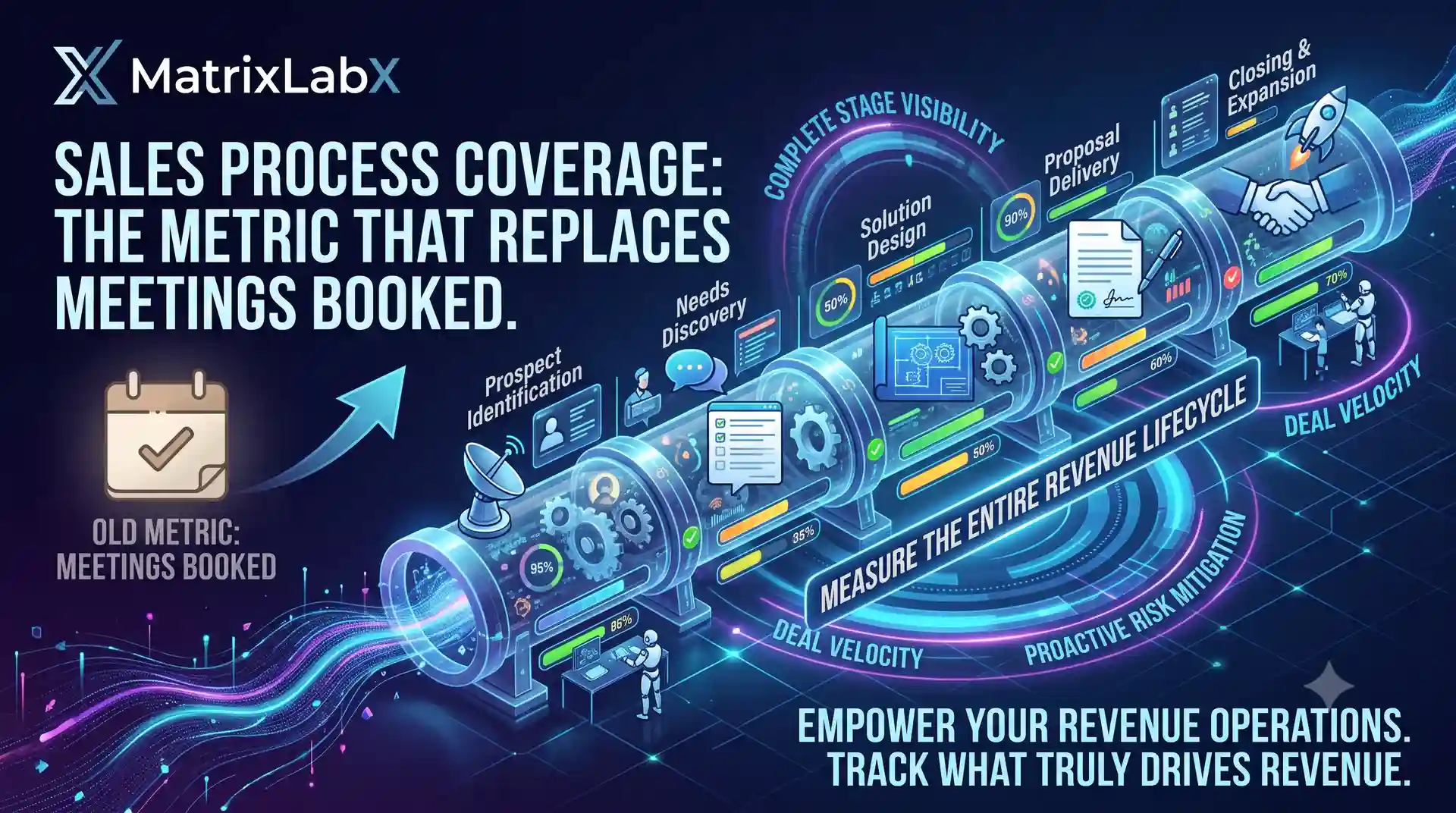
Meetings booked is a local optimum that buyers resent and CFOs cannot defend. Sales process coverage measures how far a buyer can advance on their own — and it changes what you build.
Anyone who came up through conversion optimization learns one lesson early and never unlearns it: you can win the click and lose the customer.
There are dozens of tricks that lift a click-through rate. Most of them are false wins. If the lift is not aligned with the rest of the buyer's journey, boosting that number is not neutral — it is actively working against the outcome the number was supposed to proxy for. Local optimization beating global optimization is the oldest failure in performance marketing.
The AI SDR category rediscovered it at scale, and the metric it rediscovered it with is meetings booked.
Why the metric produces the behavior buyers hate
An agent optimized for meetings booked will book meetings. That is not a defect. It is compliance with the objective function.
It will book meetings with prospects who are a poor fit, because a poor-fit meeting still increments the counter. It will book meetings that will no-show, because the no-show happens after attribution. And it will book meetings with buyers who would have preferred a straight answer, because the objective function has no term for the buyer got what they needed without a call.
The buyer's verdict on this is already in. When marketing leaders were surveyed about sell-side AI technologies from the receiving end — as prospects rather than operators — AI SDRs were the most negatively rated category by a wide margin, judged unfavorably by 59% to 64% depending on inbound versus outbound context.
The same respondents were enthusiastic about a different application. Seventy-two percent expected that AI helping sales reps answer their questions better would improve their experience as a buyer.
The conclusion is not subtle. Buyers want to buy. They do not want to be sold.
The replacement metric
The alternative is sales process coverage: how far a buyer can advance their own journey, faster, with fewer friction points.
It is a better metric for three reasons that survive scrutiny from both a growth executive and a CFO.
It is dual-optimizing. Coverage improves for the buyer and the seller simultaneously. There is no version of “the buyer got further, faster, with less friction” that hurts the seller. Meetings booked has an obvious adversarial mode. Coverage does not.
It correlates with the outcomes you actually report. Buyers who self-advance further before human contact produce shorter cycles and higher win rates. That is not a claim about agent quality — it is a claim about removing artificial gates from a process the buyer was already trying to complete.
It is honest about the human. Coverage does not mean the buyer is prevented from talking to a person. It means the meeting happens when the buyer chooses it, for a purpose self-service cannot fulfill. That is a better meeting for the rep too.
The market data supports the shape of this. 6sense's 2025 Buyer Experience Report, drawn from roughly 4,000 global B2B buyers, found that first contact with a seller now occurs at 61% of the buying journey, moved up from 69% the prior year — buyers are engaging earlier — while the winning vendor was already on the Day One shortlist 95% of the time. (6sense) The pre-contact stretch is where the decision forms. Coverage is the metric that measures whether you are useful during it.
Here is where the metric stops being a dashboard preference and starts being a build specification.
An agent whose action repertoire tops out at scheduling covers exactly one step of the journey: the step where a meeting gets booked. Every other need — a demo, a technical validation, a pricing scenario, an updated record — falls back to a human, with all the delay that implies.
Coverage is therefore a direct function of action breadth. To move the metric, an agent has to be able to do more things, in more places, with intact context.
That is the difference between a Level 3 AI SDR and the Level 4–5 architecture described in the pillar on revenue operating systems. PrescientIQ's Revenue Accelerator distributes coverage across four lifecycle agents under one orchestrator:
- Scout — scores accounts on firmographic and intent signals, so a touch is justified before it happens.
- Herald — drafts outreach grounded in the specific signal that triggered it. It does not send. No externally visible action dispatches without human approval.
- Guide — carries product-led motions, meeting buyers inside the product where evaluation actually occurs.
- Steward — runs post-close on adoption, renewal risk, and growth using the full acquisition history rather than a fresh record.
The orchestrator is the part that makes coverage measurable rather than aspirational. Four agents operating independently produce four disconnected step-level wins. Four agents sharing state produce a continuous path — which is what the buyer experiences and what the metric is trying to capture.
Two engineering decisions coverage depends on
Coverage claims collapse in production for predictable reasons. Two design choices prevent the common ones.
Deterministic math on anything consequential. Scoring, upgrade, and tier logic run in sandboxed deterministic code, never on model arithmetic. Generative models make producing an answer trivial; producing the correct answer reliably is the hard problem. “Confidently wrong” is tolerable in a brainstorm and a liability event in a pricing conversation.
Human approval as architecture, not configuration. The approval gate on externally visible actions is a structural property of the dispatch path, not a toggle a growth team can quietly disable at quarter-end. This is also the learning loop: reviewer decisions are the training signal, which is why the system targets a ≥85% human-in-the-loop approval rate as agents improve against reviewer judgment. (Modeled target, not observed production result.)
How to instrument it
Coverage is measurable without a new data warehouse. Define the buyer-facing steps in your process — question answered, fit established, demo delivered, pricing scenario produced, stakeholder looped in, technical validation passed, contract question resolved — and measure, per opportunity:
- Steps completed without human intervention as a share of total steps
- Step-to-step latency, because friction is mostly waiting
- Point of human contact, expressed as a percentage of journey completion
- Escalation quality — did the human inherit full context, or restart the conversation?
- Meeting purpose rate — what share of booked meetings could not have been resolved by self-service?
That last one is uncomfortable to instrument and the most diagnostic thing on the list. A Level 3 system will not like the answer.
The reframe
The category's original sin was not automation. It was choosing a metric that rewards volume against a buyer population that overwhelmingly said volume was the problem.
Coverage is the correction. It asks a different question — not how many meetings did we extract, but how much of the journey could the buyer complete with us. That question produces a different product, and a defensible one.
Measure how far your buyers can get on their own.
Book a Discovery Call →Related
- Pillar: Beyond Level 5: The Three Axes of an AI Revenue Operating System
- Glass-Box Compliance: Why AI Governance Has to Sit on the Execution Path
- The Shortlist Is Set Before You Know They Exist
- The rep-level diagnostic layer under this argument: Which SDR Metrics Actually Predict Pipeline?
Sources
- 6sense, “2025 B2B Buyer Experience Report,” November 12, 2025. Link
- Scott Brinker, “Could you have AI sales agents that buyers would actually appreciate?” — survey of marketing leaders on sell-side AI evaluated from the buyer's perspective; source of the 59–64% and 72% figures and the sales process coverage framing.
See where your own execution effort is going
The Autonomous Audit Report models where your team's execution capacity is currently spent, what your configuration is actually paying for, and what the governed alternative looks like on your own data — before any commitment.
Get your free AAR benchmark