Beyond top-of-funnel: how full revenue loop digital labor drives mid-market SaaS growth
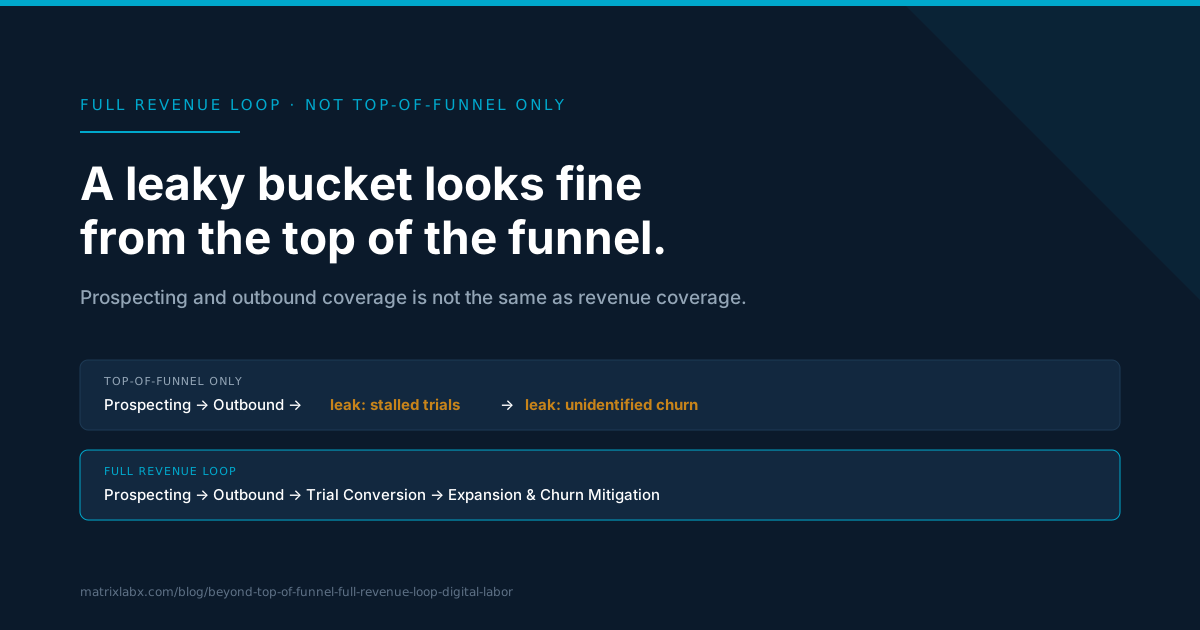
Point-tool automation focuses almost entirely on top-of-funnel outbound. That fills the pipeline while leaving two leaks unmanaged: stalled trials and churn nobody sees coming. Full revenue loop coverage closes both — coordinated agents across prospecting, outbound, trial conversion, and expansion, under one approval process.
Ask yourself three questions. Where does pipeline stall today — finding accounts, working them, converting trials, or expanding customers? If you could add execution capacity without adding headcount, where would it go first? And what happened the last time an AI tool went through your Security review?
Most answers to the first question land on prospecting or outbound, because that is where most AI tooling in this category already lives. That is also exactly why it is the wrong place to stop looking.
A leaky bucket looks fine from the top
Generating initial pipeline interest is valuable and visible — more meetings booked, more sequences sent, a dashboard trending up. Exclusively optimizing acquisition creates a leaky bucket if mid-funnel conversion and post-sale expansion stay unmanaged: the top-of-funnel dashboard looks identical whether the rest of the motion is healthy or quietly leaking revenue at the next two stages.
Mid-market SaaS enterprises ($20M–$500M ARR) are moving to full revenue loop automation for exactly this reason — coordinating specialized agents across every phase of the customer journey so RevOps captures value at each stage rather than only the first one. We cover the structural reason single-stage tools stop where they do in a companion post; this one focuses on what full coverage looks like in practice.
The four stages of the governed revenue loop
Evaluates live product telemetry, CRM entries, and buyer-intent signals continuously, then scores target accounts against a deterministic model instead of a stale, hand-built list.
Drafts sequence messages grounded in verified trigger signals — a leadership change, a technology-stack update, an operational shift — and holds every draft in an authorization queue for human review before it sends.
Tracks in-product usage against expected activation milestones and generates a targeted intervention the moment an account stalls, rather than after it has gone quiet for a full quarter.
Monitors usage trends for growth signals and early churn indicators, surfacing them long before the next formal renewal cycle would have caught them.
The economics: Labor-as-a-Service vs. seat-based SaaS
Moving from disconnected point tools to a coordinated loop changes the underlying economics, not just the workflow. Seat-based SaaS accumulates license costs across tools that do not talk to each other — cost that climbs with headcount regardless of what that headcount actually produces. Labor-as-a-Service prices the work itself: one platform fee for agents that execute across all four stages, rather than a per-seat charge for software a person may or may not fully use.
That reframes what growth costs. Adding execution capacity for a growth push does not require a proportional headcount increase, and a pre-deployment audit models the expected return on your own CRM data before any commitment — diligence before spend, not after.
| Component | Investment | Billing frequency |
|---|---|---|
| Annual platform feeEnvironment provisioning on Google Cloud, per-agent IAM, audit-ledger setup, and context ingestion from your CRM — plus four cooperating agents (Scout, Herald, Guide, and Steward), their coordinator Marshal, the approval queue and standing-policy controls, and the immutable audit ledger, and the monthly execution volume a typical mid-market deployment runs. One fee, from signature, every year.Target — modeled: live in 21 days or less$165,000/year is the complete platform fee. There is no separate implementation charge and no different first-year number — deployment work is included from signature, not billed as a distinct line. Scope beyond a typical deployment — additional bundles, sustained higher volume — is quoted at your AAR before anything is signed. | $165,000/yr | Billed monthly at $13,750/mo against an annual commitment |
Full scope and current terms are on our pricing page.
Three modeled scenarios
The scenarios below illustrate how the four-agent workflow is designed to behave for a typical mid-market account. They are modeled, not measured— directional targets built from the workflow’s design logic, not results reported from a completed customer deployment. See the notes at the end of this post for what that distinction means in practice.
1. The mid-funnel “stalled deal” resuscitator
The challenge: mid-market SaaS deals commonly stall for two or more weeks after a demo, because the account executive is already juggling new discovery calls and has no bandwidth left to nurture a quiet opportunity.
How the workflow is designed to respond: when a deal goes quiet, an agent analyzes the prospect’s demo engagement data to find what actually held their attention — in this model, time spent on a predictive analytics dashboard — and cross-references that against recent trends in the prospect’s sector. It drafts a hyper-personalized follow-up, out of the AE’s own inbox, built around a relevant case pattern rather than a generic check-in. If the prospect replies with a technical question, the agent interprets the intent, drafts the response for the AE to review, and proposes a calendar slot for both parties.
| Metric | Before | Modeled, with the workflow | Change |
|---|---|---|---|
| Average sales cycle length | 64 days | 47 days | −26.5% |
| Demo-to-closed-won rate | 22% | 31% | +9.0 pts |
| AE administrative time | 12 hrs/week | 3 hrs/week | −75.0% |
2. The product-led expansion & upsell engine
The challenge: net revenue retention is a top valuation driver, but account and customer success teams are often reactive — initiating upsell conversations only at renewal or a scheduled quarterly business review, well after a usage spike already signaled the opportunity.
How the workflow is designed to respond: when usage or login frequency approaches a plan’s soft threshold, an agent calculates the account’s concrete realized value instead of firing a generic quota-exceeded alert, then deploys an in-app prompt and an email sequence built around that specific number, positioning the next tier as a natural extension of results already achieved. In parallel, it opens a high-priority CRM task for the customer success manager, pre-populated with the account’s actual usage metrics.
| Metric | Before | Modeled, with the workflow | Change |
|---|---|---|---|
| Time to upsell trigger | 90–180 days (QBR/renewal) | Within 48 hours of the usage spike | Order-of-magnitude faster |
| Net revenue retention | 104% | 116% | +12.0 pts |
| Expansion pipeline velocity | 42 days | 14 days | −66.6% |
3. The contract renewal & risk-mitigation loop
The challenge: churn is often silent. When a product champion leaves a customer organization, usage quietly drops and the account slides into high-churn risk months before the contract is even up for renewal — long before a standard health-score check would flag it.
How the workflow is designed to respond: ahead of a renewal window, an agent flags an anomalous usage drop, then maps the organizational change behind it — in this model, identifying that the prior champion left and a new stakeholder has taken over the relevant function. It triggers a re-onboarding sequence built around that new stakeholder’s priorities rather than a generic pitch, and once engagement stabilizes, drafts the renewal agreement with standard terms for the economic buyer to review and sign.
| Metric | Before | Modeled, with the workflow | Change |
|---|---|---|---|
| Gross revenue retention | 89% | 96.5% | +7.5 pts |
| At-risk account identification | 30 days before renewal | 90 days before renewal | +60 days earlier |
| On-time renewal rate | 71% | 93% | +22.0 pts |
Where the data runs
PrescientIQ is hosted and operated by MatrixLabX on Google Cloud. SOC 2, ISO 27001, and PCI DSS attestations are held by Google Cloud, which operates the underlying infrastructure. They are not MatrixLabX certifications. MatrixLabX application-layer SOC 2 is in progress.
What this does not solve on its own
Full-loop coverage does not remove the judgment calls at each stage — someone still owns what “good” looks like for an approved draft, and the agents inherit whatever your CRM data already is. The place to find out whether your own data and stack support this before committing to anything is the free Autonomous Audit Report, modeled on your own numbers.
Frequently Asked Questions
- Are the three scenarios in this post real customer results?
- No — they are modeled scenarios illustrating how the four-agent workflow is designed to behave, not measured outcomes from a completed deployment. We are in a founding pilot program, not years into a customer base with case studies to report. The figures are directional targets, not guarantees, for exactly that reason.
- What is Labor-as-a-Service, and how is it different from SaaS pricing?
- SaaS pricing scales with seats — more users, more licenses, more cost, regardless of output. Labor-as-a-Service prices the work itself: one platform fee for the agents that execute prospecting, outbound, trial conversion, and expansion, rather than a license per person who might use a tool.
- Why does covering only prospecting and outbound create a "leaky bucket"?
- Because pipeline generated at the top still has to survive trial conversion and then expand or renew, and most point-tool automation stops before either of those stages. A full pipeline and a leaking one look identical from the top of the funnel — the leak only shows up in conversion and retention numbers, usually too late to intervene.
- What triggers Guide to intervene?
- A stall against expected activation milestones, not a fixed calendar date — the agent tracks in-product usage continuously and generates a targeted intervention when an account goes quiet before reaching the activation point that predicts conversion.
- How does an expansion agent know when to reach out?
- It watches usage trends against plan thresholds rather than waiting for a quarterly business review or a renewal date. A usage spike approaching a plan limit is a signal worth acting on in days, not the quarter it would otherwise wait for.
- Does this replace Customer Success Managers or Account Executives?
- No. The agents handle continuous monitoring and first-draft outreach; a named human still approves what goes out and owns the relationship. The CSM or AE gets a pre-built case instead of having to notice the signal manually in the first place.
Related Reading
Notes on the figures
The three scenarios above are modeled illustrations of how the four-agent workflow is designed to behave for a typical mid-market account, built from the workflow’s design logic — not measured results reported from a completed customer deployment. MatrixLabX is currently available through a founding pilot program; we do not yet have a mature customer base to report case-study results from, which is exactly why the Autonomous Audit Report is offered free, modeled on your own data, before any commitment. Pricing renders live from the site's claims register and is current as of the date on this post. No comparative performance claim is made about any named vendor or product.
See where your own execution effort is going
The Autonomous Audit Report models where your team's execution capacity is currently spent, what your configuration is actually paying for, and what the governed alternative looks like on your own data — before any commitment.
Get your free AAR benchmark