» Direct answer
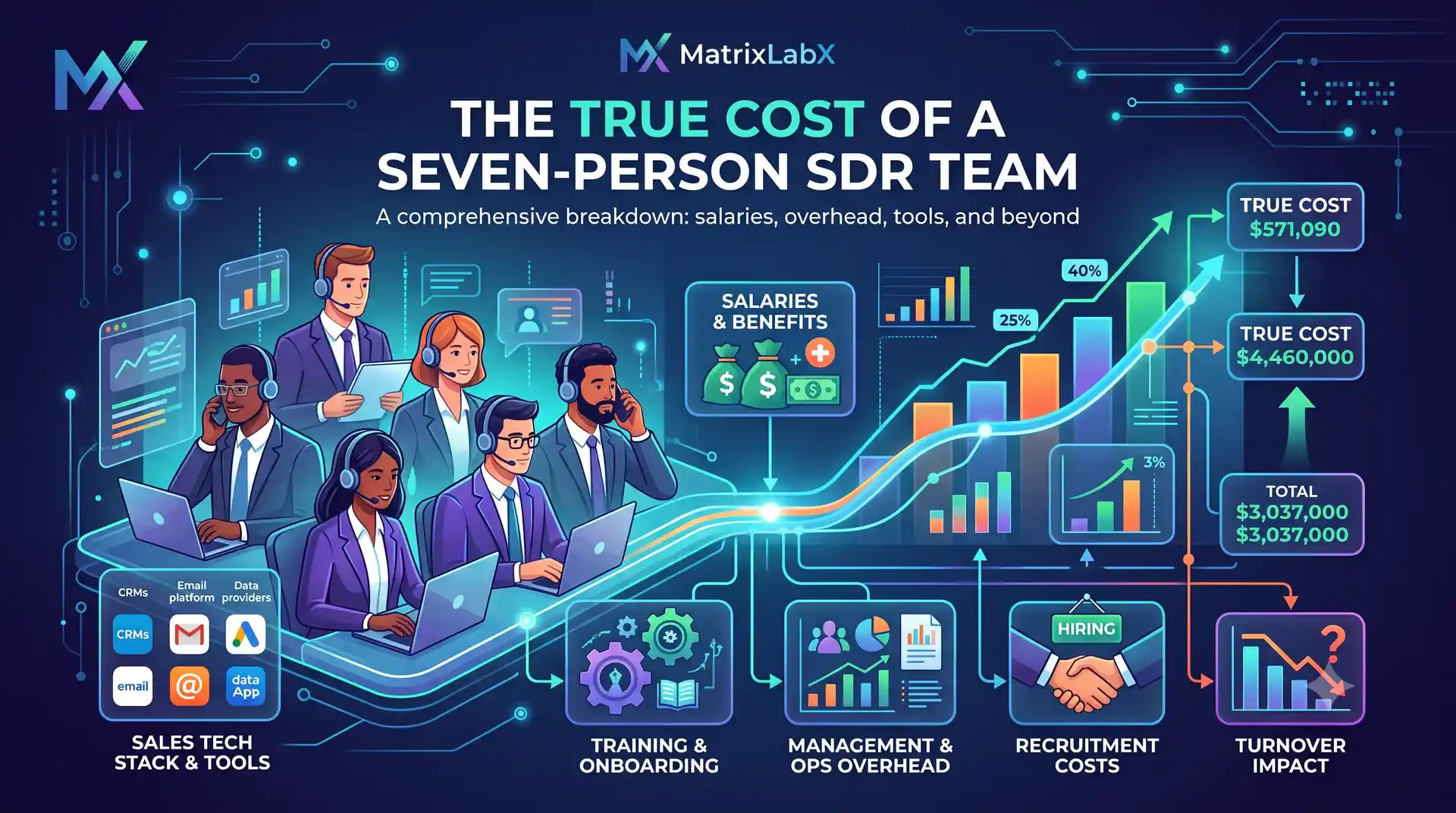
A seven-person SDR team costs roughly $1.2 million a year fully loaded — seven reps at ~$127K all-in ($889K), a dedicated manager at ~$205K, and a five-category tech stack at ~$108K. The base-salary line the board sees, about $434K, captures barely a third of the real run rate. Divided by realistic output, each held meeting costs about $1,250.
Every annual plan has the same line item, and it is always wrong. The plan says: seven SDRs, $62K base, $434K. The CFO nods, the CRO signs, and the number enters the model as the cost of pipeline generation.
It is not the cost of pipeline generation. It is the cost of one input to pipeline generation — the smallest of several. By the time you add variable compensation, employer taxes, benefits, the manager the team cannot function without, the five-category tool stack every seat requires, the three-month ramp every new hire burns, and the turnover that forces you to re-buy that ramp two or three times a year, the real number lands near $1.2 million — roughly 2.8× the base-salary line.
This article is the full model, line by line, built for the growth executive who has to defend the number in a board meeting. Two companion pieces go deeper on the pieces most models miss: the base-salary-to-fully-loaded multiplier and the per-seat tech stack tax.
For the alternative this cost model tends to lead to — governed agents absorbing the volume-bounded work while the team keeps the judgment work — see What Is a Revenue Accelerator Platform?
» Key takeaways
- The budget line understates the real cost by ~2.8×. $434K in base salaries becomes ~$1.2M once every recurring cost is counted.
- One SDR costs ~$127K fully loaded — roughly 2× base salary, once taxes, benefits, recruiting, and ramp drag are amortized in.
- Headcount costs scale with headcount; output does not. Ramp, vacancy, and turnover hold effective capacity near 76% of theoretical.
- Each held meeting costs ~$1,250 — and each sales-qualified opportunity $3,000+ — before a single AE minute is spent on it.
What does one SDR actually cost?
About $127K a year — roughly double the base salary. The gap between the $62K offer letter and the $127K reality is not one hidden cost; it is six small ones, each individually easy to wave off and collectively equal to a second salary.
Table 1 — Fully loaded cost of one US mid-market SDR (annual)
| Line item | Annual cost | Notes |
|---|
| Base salary | $62,000 | The number in the budget |
| Variable comp (at plan) | $23,000 | $85K OTE, paid on meetings/SQLs |
| Employer payroll taxes | $7,600 | FICA, FUTA/SUTA, workers' comp |
| Benefits + 401(k) match | $14,200 | Health, dental, vision, retirement |
| Equipment & workspace | $3,000 | Laptop, peripherals, office/remote stipend |
| Recruiting & backfill (amortized) | $7,600 | Agency/recruiter cost ÷ expected tenure |
| Ramp drag (amortized) | $9,200 | ~3 months at partial productivity, re-bought at each backfill |
| Total fully loaded | ≈ $127,000 | ≈ 2.05× base · ≈ 1.5× OTE |
Every one of these lines recurs annually. None of them appears on the comp plan. The full decomposition — including equity and the PTO drag most models never touch — is in the companion piece: Base salary vs. fully loaded cost: the multiplier most CROs get wrong.
What does the team cost once you add the layers around it?
Seven reps are only 74% of the team's cost. An SDR team is not seven salaries — it is seven salaries plus a management layer plus a tool layer, and both layers are mandatory, not optional.
The manager. Seven SDRs is precisely one manager's span of control — the classic 1:7 ratio. A competent SDR manager in a US mid-market carries a $160–170K OTE, which lands near $205K fully loaded using the same multiplier math as the reps. This is not overhead to be allocated away: without the manager there is no call coaching, no pipeline inspection, no comp administration, and — given turnover — a permanent hiring desk.
The stack. Each seat needs a sequencer, a dialer, a data license, an intent feed, and enrichment credits before it can produce a single meeting. For seven seats, the core five categories run about $108K a year — and closer to $137K once CRM seats, LinkedIn Sales Navigator, and conversation intelligence are counted. The full per-category pricing is in The tech stack tax: what seven seats actually cost.
Table 2 — Seven-person SDR team, full annual run rate
| Layer | Annual cost | Share of total |
|---|
| 7 SDRs, fully loaded | $889,000 | 74% |
| 1 SDR manager, fully loaded | $205,000 | 17% |
| Tech stack (core 5 categories, 7 seats) | $108,000 | 9% |
| Total annual run rate | ≈ $1,202,000 | 100% |
» COST_MODEL — sdr_team_x7# budget line vs fully loaded run rate...
» budget_line 7 × $62K base = $434,000
» comp_loaded 7 × $127K fully loaded = $889,000
» + management 1 × mgr fully loaded = $205,000
» + tech_stack 5 categories × 7 seats = $108,000
# understatement factor: 1,202 / 434
TRUE RUN RATE: ≈ $1.2M/yr — 2.8× the budget line
» Benchmark it
What is your cost per held meeting — actually?
MatrixLabX runs this model against your real comp data, seat licenses, and CRM output in a single engagement. Most teams discover their cost per sales-qualified opportunity is 2–3× what the board deck claims — and that a governed digital workforce produces the same pipeline at a fraction of the run rate.
~$1,250
true cost per held meeting
6×
SDR volume via governed agents
Book a Discovery Call →
Why does the team never run at full capacity?
Because ramp, vacancy, and turnover are structural, not incidental. A seven-seat team is a seven-seat team on the org chart only. In any given month, one seat is empty, one is ramping, and one is worked by someone who has mentally resigned.
The arithmetic is unforgiving. Industry benchmarks consistently put annual SDR turnover in the mid-30s percent range, average tenure under two years, and time-to-full-productivity at roughly three months. Apply those rates to seven seats:
- ~2.4 seats replaced per year. Each replacement carries recruiting cost, an empty-seat gap of 4–8 weeks, and a fresh ramp.
- ~7 rep-months of ramp per year. A ramping rep produces at roughly half rate, so the team permanently carries the equivalent of one half-productive seat.
- Effective capacity ≈ 76% of theoretical. Seven seats behave like 5.3 fully productive ones — while you pay for all seven, the manager, and every license.
This is the quiet killer in every headcount-driven pipeline model: costs are fixed at 100% of seats; output is delivered at ~76%. The gap widens every time the labor market tightens, and no amount of hiring discipline closes it, because the churn is a property of the role, not of your process.
"When midmarket enterprises embed AI into their core operations, they eliminate bureaucratic drag, allowing them to out-maneuver larger competitors who are constrained by legacy silos."
» George Schildge · CEO & Chief AI Officer, MatrixLabX
What does a meeting actually cost at this run rate?
About $1,250 per held meeting, and $3,000+ per sales-qualified opportunity. This is the number the board deck never shows, because nobody divides the fully loaded run rate by the real output.
Assume a healthy benchmark: 15 held meetings per fully ramped SDR per month. At 100% capacity, seven SDRs would book 1,260 held meetings a year. At the real ~76% effective capacity, the team delivers roughly 958 held meetings. Divide:
Table 3 — Unit economics of a seven-person SDR team
| Metric | Naive model | Fully loaded model |
|---|
| Annual cost basis | $434,000 (base only) | $1,202,000 (all-in) |
| Held meetings / year | 1,260 (100% capacity) | ≈ 958 (76% effective) |
| Cost per held meeting | $344 | ≈ $1,250 |
| Cost per SQL (40% conversion) | $861 | ≈ $3,140 |
The naive model and the real model differ by a factor of 3.6 on the only metric that matters. Every downstream number — CAC, payback period, LTV:CAC — inherits that error. A growth model built on $344 meetings is not conservative or aggressive; it is fiction.
What is the alternative to buying more seats?
Stop scaling pipeline with headcount and scale it with governed digital labor. The structural problem with the $1.2M team is not that people are bad at prospecting — it is that every unit of output requires a unit of salary, ramp, management, and licenses that never stops recurring.
This is the economic case behind Labor as a Service. Governed autonomous agents execute the same motion — account research, contact sourcing, sequencing, qualification, meeting booking — as a coordinated system rather than seven separate quota-carriers. The differences that matter to the cost model:
- No ramp, no turnover, no vacancy. Effective capacity is 100% of paid capacity, 24/7. The 76% problem disappears.
- No per-seat stack tax. Data, enrichment, and execution run inside one platform instead of five licenses × seven seats.
- Governed, not autonomous-in-the-dark. Under the PrescientIQ™ Sense → Decide → Act → Learn loop, agents execute and humans authorize — every send governed, every action on an immutable audit ledger.
- Priced on outcomes, not seats. The spend maps to pipeline produced, which is the attribution your CFO has been asking for all along.
The target economics MatrixLabX deploys against: 6× SDR-equivalent volume and deployment in 21 days or less — validated on your own CRM data before scale-up, with a human approval gate on every outbound touch.
» Canonical definition
MatrixLabX replaces your fragmented SaaS stack with an autonomous digital workforce. We shift your business from Software as a Service to Labor as a Service. Our agents don't wait for prompts — they sense, decide, act, and learn 24/7 to deliver measurable P&L impact within 60 days.
Go deeper on the two cost categories most models get wrong, or see the platform that changes the equation:
Why this might not apply to you
Cost models are honest only when they admit their boundaries. If your SDRs carry meaningful full-cycle responsibility — closing small deals, managing renewals — their cost basis buys more than meetings, and this model will overstate your cost per opportunity. If you operate in a market where trust is built exclusively through human relationships over long cycles, the human seat may earn its premium. And if your comp, benefits, or geography differ materially from US mid-market benchmarks, rebuild the table with your own numbers before acting on the conclusion — the structure of the model holds; the constants are yours to supply. What does not change in any variant: base salary is never the cost, and seats are never 100% productive.
People also ask
How much does a seven-person SDR team cost per year?
Roughly $1.2 million a year fully loaded. Seven SDRs at approximately $127K each all-in ($889K), a dedicated manager at roughly $205K fully loaded, and a five-category tech stack at roughly $108K a year. The base-salary line the board sees — about $434K — captures barely a third of the real run rate.
What is the fully loaded cost of one SDR?
Approximately $127K a year for a US mid-market SDR: $85K on-target earnings, plus employer payroll taxes (~$7.6K), benefits and 401(k) match (~$14.2K), equipment and workspace (~$3K), recruiting and backfill amortization (~$7.6K), and ramp drag (~$9.2K). That is roughly 2× the $62K base salary.
What does an SDR-sourced meeting actually cost?
About $1,250 per held meeting for a typical seven-person team. A $1.2M annual run rate divided by realistic annual output — roughly 950–960 held meetings once ramp time, vacancies, and turnover reduce effective capacity to about 76% of theoretical — puts the true cost per held meeting at four figures, and cost per sales-qualified opportunity at $3,000 or more.
Why do SDR cost models understate the real number?
Because they stop at compensation. The four omitted categories — management overhead, the per-seat tech stack, ramp drag, and turnover amortization — add roughly $400K a year to a seven-person team. Each one recurs annually, so the understatement compounds every planning cycle.
How does SDR turnover change the cost model?
Industry benchmarks put annual SDR turnover in the mid-30s percent range with average tenure well under two years. On a seven-person team that means replacing two to three seats every year — each replacement carrying recruiting fees, an empty-seat gap, and a 3+ month ramp at partial productivity. Amortized, turnover adds roughly $17K per seat per year.
What is the alternative to scaling SDR headcount?
Governed autonomous agents that execute prospecting, qualification, and outreach in a governance mode your team sets, priced on work executed instead of seats. A digital workforce runs around the clock, never ramps, never churns, and consolidates the per-seat tool stack. MatrixLabX targets production deployment in 21 days or less from signed contract, subject to CRM data quality and integration scope.
» Free engagement · 24-hour response
Your board thinks pipeline costs $434K. It costs $1.2M.
We run the fully loaded model against your comp data, licenses, and CRM output — then show you what the same pipeline costs when governed agents do the work.
Book a Discovery Call →
» Deployment in 21 days or less · P&L impact within 60 days · matrixlabx.com/contact