How to fix declining SaaS sales without hiring more reps
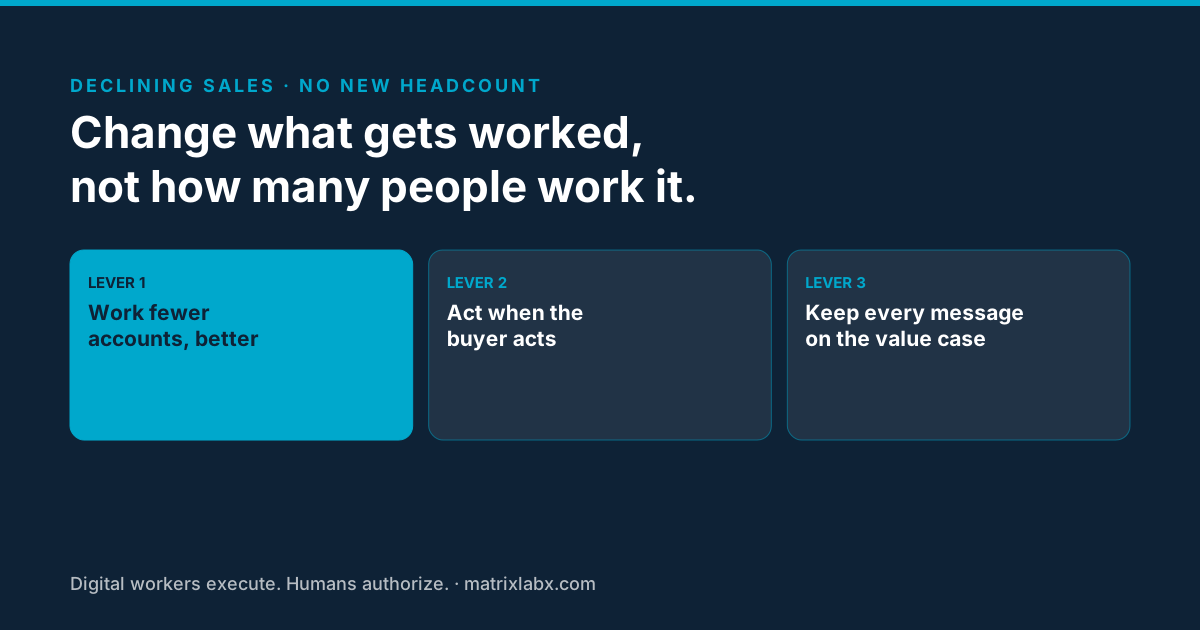
Short answer: adding reps to a declining sales motion adds fixed cost to a variable problem. Mid-market SaaS teams recover faster by changing what gets worked, not how many people work it: target only accounts with real buying signals, follow up at the moment a buyer acts, and put digital labor under governance so the extra execution never reaches a buyer without the oversight your team sets.
Why is headcount the wrong first lever?
When bookings fall, the instinct is to hire. But new reps take quarters to ramp, they carry fixed salary from day one, and they inherit the same targeting and follow-up gaps that caused the decline. Your CFO sees CAC payback stretch before a single new deal closes. What a seat really costs is worked through in base salary vs. fully loaded SDR cost, and you can run your own numbers in the fully loaded SDR cost calculator.
The buyer has also changed. Gartner’s March 2026 sales survey found that 67% of B2B buyers prefer a rep-free experience, up from the 61% Gartner reported in June 2025. More reps sending more outreach works against that preference. Volume is not the fix. Relevance and timing are.
Lever 1: How do you work fewer accounts, better?
Cut the target list to accounts that match your ICP and show a current buying signal: intent data, a hiring change, a funding event, product usage, a competitor’s renewal window. Every hour a rep spends on an account with no signal is an hour taken from one that has one. If you have not yet found where your pipeline leaks, run the five-point pipeline leak diagnostic first.
Lever 2: How do you act when the buyer acts?
Most declining teams do not lack data. They lack the capacity to act on it the same day. A pricing-page visit on Tuesday that gets a generic sequence on Friday is a lost moment. Speed to a relevant, specific response is where capacity matters most, and speed to lead shows which stages of the delay need no human judgment at all.
Lever 3: Why must every message match the value case?
When deals are lost to “no decision,” inconsistency is often the reason buyers stall: the website says one thing, the rep another, the proposal a third. Every outbound message should carry the same value case your website and your CFO deck make, built on the metrics the buyer’s CFO owns.
Why did the last three fixes not work?
| Approach | What you pay for | What happens on a declining team |
|---|---|---|
| Seat-based SaaS | Licenses, used or not | Adoption is your problem; cost is fixed while output is not |
| Copilots | Seats for faster drafting | Nothing happens until someone prompts it; it adds no hours |
| Ungated AI SDR tools | Send volume | Scales volume and domain risk together, with no review step |
| Governed Labor as a Service | The work itself | Agents do the work; your team sets what waits for approval |
The pricing difference between the models is set out in LaaS vs. SaaS, and the cost comparison against a hire in AI SDR vs. human SDR.
What does governed digital labor look like in practice?
PrescientIQ™ deploys specialist digital workers that execute the three levers above:
- Scout, the Pipeline Research Analyst, scores accounts against your ICP from intent signals and CRM records, so effort goes to accounts with a reason to buy now.
- Herald, the Outbound Engagement Rep, drafts personalized, multi-channel outreach grounded in the signal that triggered it. Each draft is held until a named person on your team approves it. Inside Herald shows the approval flow.
- Marshal, the Revenue Operations Coordinator, routes work across the crew, and every action, approval, and rejection is recorded to the audit ledger, so you can show what went out and why.
Your team sets the oversight for each kind of action:
Human-in-the-loop (HITL). The action is drafted and held. It does not execute until a named person on your team approves it.
Human-on-the-loop (HOTL). The action executes under a standing policy your team sets. A named person supervises and keeps intervention, override, and revocation authority.
Your team chooses the mode for each action class, based on its risk tolerance, and can change it at any time.
Every action, in either mode, is recorded to the audit ledger with its rationale, before-and-after state, and the approver or policy behind it.
Every action class starts in human-in-the-loop until your team changes it.
Add capacity without adding seats.
Sales Accelerator gives your team self-serve specialist digital workers on a monthly tier, metered by digital worker compute and starting at $399/mo billed annually. Your team runs the console and authorizes the work.
Prefer not to run it yourself? Managed Revenue Operations puts a named MatrixLabX operator on the console for you; your team keeps authorization.
Where the data runs
PrescientIQ is hosted and operated by MatrixLabX on Google Cloud. SOC 2, ISO 27001, and PCI DSS attestations are held by Google Cloud, which operates the underlying infrastructure. They are not MatrixLabX certifications. MatrixLabX application-layer SOC 2 is in progress.
Frequently asked questions
- Why is hiring more reps the wrong first fix for declining SaaS sales?
- Hiring more reps adds fixed salary from day one, takes quarters to ramp, and inherits the same targeting and follow-up gaps that caused the decline. CAC payback stretches before a single new deal closes. Declining SaaS sales usually recover faster when the team changes what gets worked, not how many people work it.
- Can AI replace SDRs?
- AI can execute much of the research, drafting, and follow-up an SDR does. Whether that work reaches a buyer without review is a choice your team makes. In PrescientIQ, each action class runs either held for a named person’s approval or under a standing policy that a named person supervises and can revoke.
- Will AI outreach hurt our domain reputation?
- AI outreach can hurt domain reputation when nothing is reviewed before it sends and volume rises faster than relevance. Governed digital workers hold outreach drafts for approval, and sending should run through an authenticated domain with SPF, DKIM, and DMARC configured. The Autonomous Audit Report checks those settings before any deployment.
- How is Labor as a Service priced differently from sales software?
- Seat-based sales software charges per user whether or not the work gets done. Labor as a Service prices the work itself. PrescientIQ Sales Accelerator, for example, is a monthly tier metered by digital worker compute, starting at $399 per month billed annually, with no per-seat licenses to buy.
- What is the fastest lever for declining sales without new headcount?
- The fastest lever is usually speed to a relevant response. Most declining teams already have the buying signals in their CRM but lack the capacity to act on them the same day. Responding while the buyer is active, with a message grounded in what they did, recovers deals that volume never will.
- Should we run PrescientIQ ourselves or have MatrixLabX run it?
- Teams with RevOps capacity usually run PrescientIQ Sales Accelerator themselves and approve the work in the console. Teams without that capacity choose Managed Revenue Operations, where a named MatrixLabX operator runs the platform and your team keeps authorization. The free Autonomous Audit Report recommends which fits your motion.
Related reading
Notes on this page
The two third-party figures are Gartner’s, each dated and linked to its press release. The Sales Accelerator price is the published tier price. This page states no MatrixLabX performance figures.
See where your own execution effort is going
The Autonomous Audit Report models where your team's execution capacity is currently spent, what your configuration is actually paying for, and what the governed alternative looks like on your own data — before any commitment.
Get your free AAR benchmark