New bookings slowing? How to protect the SaaS revenue you already have
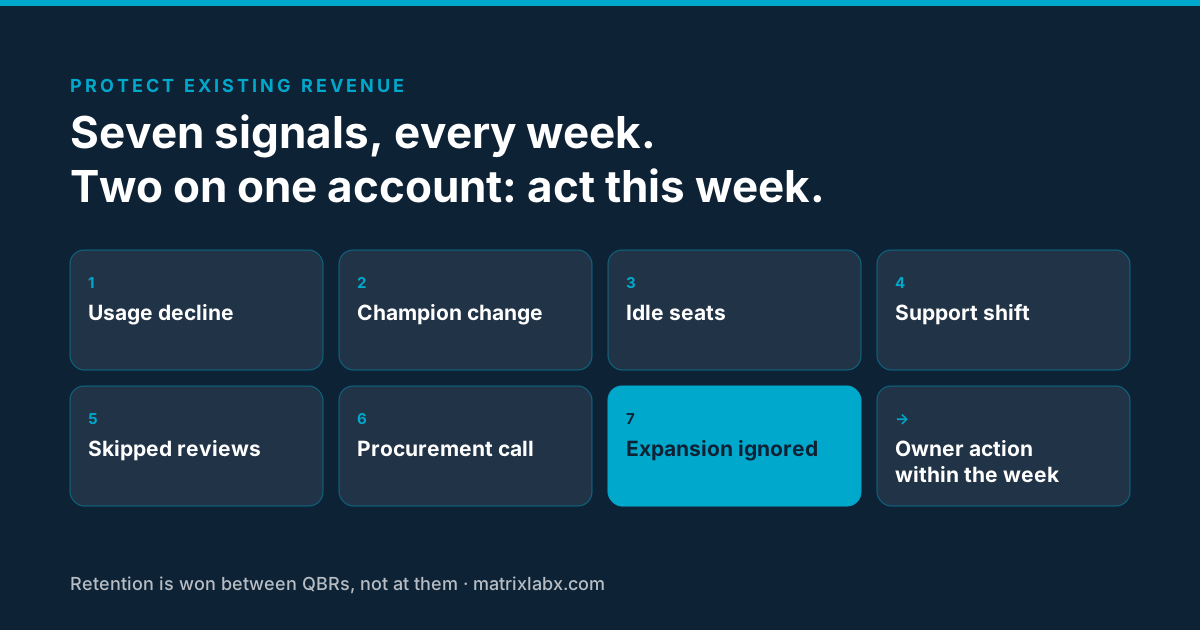
Short answer: when new-logo sales decline, your installed base has to carry the plan, at the same moment customers are cutting vendors. Retention is won between quarterly business reviews, not at them. Track seven usage and relationship signals weekly, act on any account that trips two of them, and treat expansion signals with the same urgency as churn signals.
Why do declining sales put retention at risk?
A new-bookings miss changes how the whole company behaves. Leadership leans on expansion to close the gap. Customer success gets pulled into rescue deals. Account managers focus on the biggest logos and miss the mid-tier accounts quietly disengaging. The same capacity squeeze is why adding capacity without adding headcount matters on the retention side too.
Meanwhile, your customers face the same budget pressure you do. They are reviewing every renewal, and a vendor that only shows up at the QBR is the easiest one to cut.
What are the seven early-warning signals to track weekly?
| Signal | What it looks like | The play |
|---|---|---|
| 1. Usage decline | Active users or core-feature usage falls over consecutive weeks | Activation plan for the features they bought for |
| 2. Champion change | Your main sponsor leaves, changes role, or stops responding | New sponsor map and an introduction to the successor |
| 3. Seat underutilization | Paid seats sit inactive, giving finance an easy cut at renewal | Usage review before finance runs its own |
| 4. Support pattern change | Tickets spike on one issue, or drop to zero from an active account | Escalate the issue, or check whether they stopped trying |
| 5. Skipped reviews | QBRs postponed, or attended by fewer stakeholders | Short value recap to the economic buyer |
| 6. Procurement contact | Finance or procurement reaches out before the team expects a renewal talk | Bring the renewal conversation forward |
| 7. Expansion signal ignored | An account approaches its usage allowance and nobody brings a proposal | Expansion proposal before the limit is hit |
The seventh is the one teams forget. An account outgrowing its plan with no offer from you is an account open to a competitor’s. For the full signal families and typical lead times, see SaaS churn signals: what to watch and when. Seat-based products face a second pressure as customers automate roles, covered in seat compression and SaaS NRR.
What does the weekly retention playbook look like?
- Score every account every week against the seven signals, not just the top 20 by ARR.
- Flag any account with two or more signals for an owner-assigned action within the week.
- Match the play to the signal. Usage decline gets an activation plan. Champion change gets a new sponsor map. Approaching a usage limit gets an expansion proposal.
- Record what happened. Every flag, action, and outcome goes in one log, so the next review starts from facts.
The playbook is simple. Running it every week for every account, with a team stretched by a bookings miss, is the hard part. The metrics it protects, NRR and GRR, are defined with their levers in net revenue retention in SaaS: the operating guide.
See which accounts are at risk in your own data.
The free Autonomous Audit Report (AAR) is a read-only review of a sample of your CRM data. It maps retention and expansion risk and models the P&L impact on your own baseline before you commit. It is returned within 48 hours.
Get your free AAR Benchmark →How does PrescientIQ™ run the playbook continuously?
- Steward, the Expansion & Retention Analyst, reads post-sale usage telemetry, surfaces churn-risk signals early, and flags accounts approaching their usage allowance. It drafts mitigation plays and expansion proposals between quarterly reviews. Inside Steward covers how.
- Guide, the Trial Activation Specialist, catches the same pattern earlier in the lifecycle, flagging trial accounts that stall before their key value event. See inside Guide.
- Marshal, the Revenue Operations Coordinator, routes work across the crew, and every action, approval, and rejection is recorded to the audit ledger.
Every customer-facing proposal is held for your team to edit, approve, or reject. For internal work, your team sets the oversight mode per action class:
Human-in-the-loop (HITL). The action is drafted and held. It does not execute until a named person on your team approves it.
Human-on-the-loop (HOTL). The action executes under a standing policy your team sets. A named person supervises and keeps intervention, override, and revocation authority.
Your team chooses the mode for each action class, based on its risk tolerance, and can change it at any time.
Every action, in either mode, is recorded to the audit ledger with its rationale, before-and-after state, and the approver or policy behind it.
Every action class starts in human-in-the-loop until your team changes it.
The full specification is on the Revenue Accelerator Stack page, and the SaaS-specific view, including what stays with your counsel, is PrescientIQ™ for B2B SaaS.
Where the data runs
PrescientIQ is hosted and operated by MatrixLabX on Google Cloud. SOC 2, ISO 27001, and PCI DSS attestations are held by Google Cloud, which operates the underlying infrastructure. They are not MatrixLabX certifications. MatrixLabX application-layer SOC 2 is in progress.
Frequently asked questions
- What is the earliest sign a SaaS customer will churn?
- The earliest sign a SaaS customer will churn is usually a sustained decline in use of the core features they bought for, combined with a relationship change such as a departed champion. One signal alone is often noise. Two signals together on the same account warrant an owner-assigned action that week.
- How often should a SaaS team review churn risk?
- A SaaS team should review churn risk weekly, for every account, not just the largest by ARR. A quarterly review tends to find risk after the customer has already started evaluating alternatives, and in a declining-bookings year the mid-tier accounts nobody reviews are where retention quietly erodes.
- Can expansion revenue offset a decline in new bookings?
- Expansion revenue can close part of a new-bookings gap, but only when expansion is proactive. Accounts approaching their plan limits need a proposal before they hit the limit, not after. Waiting for the customer to ask leaves the conversation open to a competitor offering more capacity for less.
- Why do declining new bookings put existing revenue at risk?
- Declining new bookings pull leadership toward expansion, pull customer success into rescue deals, and focus account managers on the biggest logos. At the same time customers face their own budget pressure and review every renewal. Mid-tier accounts then disengage unnoticed, which is why existing revenue is at risk exactly when it matters most.
- What should happen when an account trips two warning signals?
- When an account trips two warning signals, a named owner gets an action within the week, matched to the signal. Usage decline gets an activation plan, a champion change gets a new sponsor map, and an approaching usage limit gets an expansion proposal. The flag, action, and outcome are recorded in one log.
- Does Steward contact customers without approval?
- No. Steward, PrescientIQ’s Expansion & Retention Analyst, reads post-sale signals, flags at-risk and expansion-ready accounts, and drafts the mitigation play or expansion proposal. Every customer-facing message is held until a named person on your team approves, edits, or rejects it, and every action is recorded to the audit ledger.
Related reading
Notes on this page
This page contains no third-party statistics and no MatrixLabX performance figures. The seven signals and the weekly playbook are MatrixLabX’s own framework. Any projected impact for your company is modeled on your own data in the Autonomous Audit Report and labeled as a target until validated.
See where your own execution effort is going
The Autonomous Audit Report models where your team's execution capacity is currently spent, what your configuration is actually paying for, and what the governed alternative looks like on your own data — before any commitment.
Get your free AAR benchmark