Seat compression is coming for your NRR: three governed-agent plays for mid-market SaaS
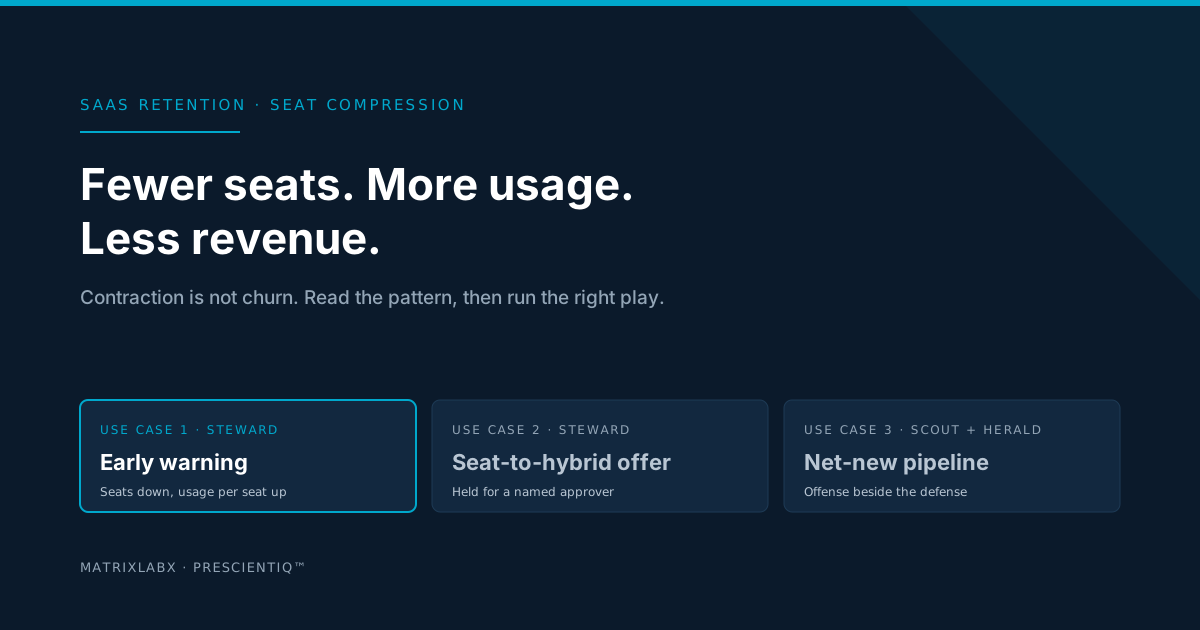
Seat compression is the drop in licensed seats that follows when customers use AI to do the same work with fewer people. Under per-seat pricing, revenue falls even when every account renews. The fix starts with telling efficiency contraction (seats down, usage per seat up) apart from disengagement churn (both down), then running the right play: an early-warning read, a seat-to-hybrid offer, or net-new pipeline.
Your customers are getting more value from your product and buying fewer seats of it. That is the seat-compression problem in one sentence, and it is now showing up in the retention data.
In the 2026 Aleph × Benchmarkit SaaS & AI Performance Benchmarks, drawn from full-year 2025 results across 342 companies, median net revenue retention was 102%. Split by pricing model, usage-based companies posted a 108% median while seat-based companies sat at 98%, below break-even. The report attributes the seat-based drag to customers consolidating roles and deploying AI agents, which shrinks their own seat counts.
The math does not need a churn event to hurt. As SaaStr has laid out, a 30% seat decline with a 10% price increase still leaves revenue down 23% (0.70 × 1.10 = 0.77). Every account renews. The number still falls.
This post is for CROs, customer success leaders, and RevOps teams at $20M–$500M ARR SaaS companies with meaningful revenue on per-seat pricing. It covers why seat compression slips past the health score, three plays governed agents can run against it, a decision tree for which play to start with, and the questions buyers ask most.
Why your health score misses it
A classic churn signal is disengagement: logins drop, usage falls, the champion goes quiet. Seat compression looks different. The customer deactivates seats while the remaining users get more active, because an AI tool or an internal agent absorbed the work the removed seats used to do.
A login-weighted health score reads that account as healthy. SBI Growth Advisory makes the same point: login frequency gives a false retention signal when fewer people produce more output, and it reports that 58% of companies saw lower NRR because AI productivity let customers hit the same output with fewer people. So there are two different patterns, and they need two different plays.
| Pattern | Seat count | Usage per remaining seat | What it means | The right response |
|---|---|---|---|---|
| Disengagement churn | Falling | Falling | The product is losing the account | Save play: re-onboard, re-sponsor, escalate |
| Efficiency contraction | Falling | Flat or rising | The product is winning; the pricing unit is losing | Repackaging play: align price to value, not headcount |
Running a save play on an efficiency-contraction account is a wasted conversation. The customer is not unhappy. They are rational. What they need is a pricing conversation, before procurement has it for them at renewal. The usage, relationship, and commercial signals that precede genuine churn are covered in the eight SaaS churn signals.
“For midmarket SaaS companies, product-led growth requires an AI-driven revenue operations engine. Using AI to analyze product usage data allows marketing and sales teams to intercept churn risks and identify expansion opportunities long before the renewal date.”
Three governed-agent plays against seat compression
Each play follows the same structure: the signal, what the agent does, what your team controls, and what to measure. All three run under the governance mode your team sets. Your team chooses the mode for each action class, based on its risk tolerance, and can change it at any time. Human-in-the-loop (HITL): The action is drafted and held. It does not execute until a named person on your team approves it. Human-on-the-loop (HOTL): The action executes under a standing policy your team sets. A named person supervises and keeps intervention, override, and revocation authority. Every action class starts in human-in-the-loop until your team changes it. Any proposal or message a customer would see is held for a named person’s approval. Every action, in either mode, is recorded to the audit ledger with its rationale, before-and-after state, and the approver or policy behind it.
Use case 1: Contraction early warning, read correctly
The signal. Seat deactivations or a falling licensed-seat count on an account, paired with flat or rising activity per remaining seat, and feature adoption that holds or broadens.
What the agent does. Steward, the Expansion & Retention Analyst, reads post-sale usage telemetry: seat utilization, usage patterns, and feature adoption across the install base. Your team writes the rule that separates the two patterns in the table above, and Steward applies it with a deterministic confidence score, so the same inputs produce the same classification. When an account matches the efficiency-contraction pattern, Steward prepares a prioritized play for the account owner between quarterly reviews: the seat trend, the usage trend, the features carrying the value, and a recommended next conversation.
What your team controls. The classification rule and its thresholds. The account decision stays with your CSMs and account owners; Steward surfaces and prioritizes, it does not decide.
What to measure. How many days before renewal each contraction account is flagged, and the share of flagged accounts where the owner opened a pricing conversation before the renewal cycle started.
Use case 2: Seat-to-hybrid migration offers, priced reproducibly
The signal. An account flagged as efficiency contraction, or approaching a usage allowance, where you already have a usage-based or hybrid tier to offer.
What the agent does. Steward drafts the expansion proposal: the current plan, the usage that justifies a different structure, and the proposed tier. Upgrade and tier math runs on sandboxed deterministic code, never on model arithmetic, so the price in the proposal is reproducible line by line. The proposal is held for a named person’s approval before anything reaches the customer.
What your team controls. Which tiers exist, the pricing rules behind them, and who approves each proposal. Offer, renewal, and cancellation terms are a question for your counsel; the platform makes the number reproducible and the approval recorded, not the terms compliant.
What to measure. Proposals approved versus rejected, with the reason recorded on each rejection; contraction ARR converted to hybrid ARR; and gross revenue retention on the migrated cohort.
Why this play matters most. The same Aleph benchmark data puts the cost of expansion at about $0.80 per dollar of new ARR, against $1.63 for new-logo acquisition. Moving a compressing account onto a structure that grows with usage is the cheapest ARR you will defend all year.
Use case 3: Net-new pipeline from the accounts going through the same shift
The signal. The forces compressing your own install base are visible in your prospects: tool-sprawl indicators, hiring changes, and funding events on accounts that fit your ICP.
What the agent does. Scout, the Pipeline Research Analyst, scores ICP-fit accounts from firmographic and intent signals sourced through licensed providers. Account scoring runs on sandboxed deterministic code. No language model performs arithmetic that has a numeric consequence, so a score can be reproduced and checked. Qualified accounts hand off with their score and the inputs behind it to Herald, the Outbound Engagement Rep. Outreach is grounded in the specific signal that triggered it, with the reasoning behind each draft captured alongside it. Every draft is held for a named approver before it sends.
What your team controls. The ICP, the scoring thresholds, the approver for each draft, and the suppression and frequency rules stated before deployment.
What to measure. Pipeline created and tied back to the workflow that produced it, signal-to-first-touch latency, and approval and rejection rates on Herald’s drafts.
Why it belongs in a retention post. When the installed base expands more slowly, net-new logos carry more of the growth plan. SaaStr notes that net revenue retention across public software has slid from roughly 116% at its peak to around 108%. A defensive motion with no offense attached shrinks more slowly, but it still shrinks.
Decision tree: which seat-compression play runs first?
Answer with last year’s renewals in front of you. Whatever the starting play, every action class begins in human-in-the-loop, and the autonomy ceiling rises only on evidence from the ledger; the framework for that call is in human-in-the-loop vs. human-on-the-loop.
Which play should run first in your install base?
What this does not fix
Agents do not set your pricing strategy. If there is no hybrid tier, Use case 2 waits on your pricing and finance teams, and no amount of telemetry changes that. Agents also do not make a weak product sticky; if the dominant pattern in your install base is disengagement, the problem is upstream of revenue operations.
We publish modeled targets, not measured customer outcomes, because PrescientIQ™ is in a founding pilot program. The free Autonomous Audit Report models these plays against your own CRM, billing, and usage data before you commit to anything. The full four-agent loop is specified on the Revenue Accelerator Stack page, and SaaS-specific applications are on PrescientIQ for B2B SaaS.
Next step
Pull every account that lost seats at its last renewal and sort it by whether usage per remaining seat rose or fell. That split tells you which play to start with, and how much ARR sits on each side of it. For the levers that move retention once the split is known, see the NRR operating guide.
Frequently Asked Questions
- What is seat compression in SaaS?
- Seat compression in SaaS is the decline in licensed seats that happens when customers use AI tools or agents to do the same work with fewer people. Under per-seat pricing, the vendor’s revenue from that account falls even when the customer is satisfied, keeps using the product, and renews.
- How is seat compression different from churn?
- Seat compression and churn both reduce seat counts, but usage separates them. Disengagement churn shows falling seats and falling usage per remaining seat. Seat compression shows falling seats with flat or rising usage per remaining seat. The first calls for a save play; the second calls for a pricing conversation before renewal.
- How much does seat compression affect net revenue retention?
- In the 2026 Aleph and Benchmarkit SaaS benchmarks, built on full-year 2025 data, seat-based companies posted a 98% median net revenue retention against 108% for usage-based companies. The report attributes the seat-based drag to AI-driven seat reductions. The effect on your own base depends on how much ARR sits on per-seat pricing.
- Can raising the price per seat offset seat compression?
- Raising the price per seat offsets seat compression only partially. A 30% seat decline with a 10% price increase still leaves an account at 77% of its prior revenue. A price increase also invites procurement scrutiny at the moment the customer is already counting seats, so it rarely closes the gap alone.
- Which PrescientIQ agent handles each seat-compression play?
- In PrescientIQ, Steward, the Expansion and Retention Analyst, handles contraction detection and seat-to-hybrid proposals. Scout, the Pipeline Research Analyst, and Herald, the Outbound Engagement Rep, handle net-new pipeline. Marshal, the Revenue Operations Coordinator, routes work across all of them and records every action to the audit ledger.
- Can an agent send a pricing proposal to a customer without approval?
- No. In PrescientIQ, any customer-facing proposal or message is held in the approval queue until a named person on your team approves, edits, or rejects it. Internal work such as classifying an account or scoring a signal can run under a standing policy your team sets, and every action is recorded to the audit ledger.
- What data do the seat-compression plays need?
- The seat-compression plays need product usage telemetry at the seat and feature level, a history of licensed seats per account, and Salesforce or HubSpot as the system of record. If the usage data cannot separate efficiency contraction from disengagement, the Autonomous Audit Report flags that as a finding before deployment.
- What does PrescientIQ cost for a SaaS company?
- The PrescientIQ Revenue Accelerator Stack is one flat platform fee of $165,000 a year, billed monthly and never per seat, with deployment work included. The self-serve Sales Accelerator starts at $399 on the Starter tier billed annually, for teams starting smaller. Both products publish their prices in full.
Related Reading
Sources and notes
- Aleph × Benchmarkit, 2026 SaaS & AI Performance Benchmarks (net revenue retention, full-year 2025 data)
- SaaStr, “Yes, Many Software Leaders Have Moats. No, That’s Not Enough.”
- SBI Growth Advisory, “The Great Unbundling”
Third-party figures were checked against their linked sources on October 11, 2026. The 77% figure is arithmetic on the stated example, not a benchmark. No PrescientIQ outcome is claimed, and product statements match the current public copy.
See where your own execution effort is going
The Autonomous Audit Report models where your team's execution capacity is currently spent, what your configuration is actually paying for, and what the governed alternative looks like on your own data — before any commitment.
Get your free AAR benchmark