» Direct answer
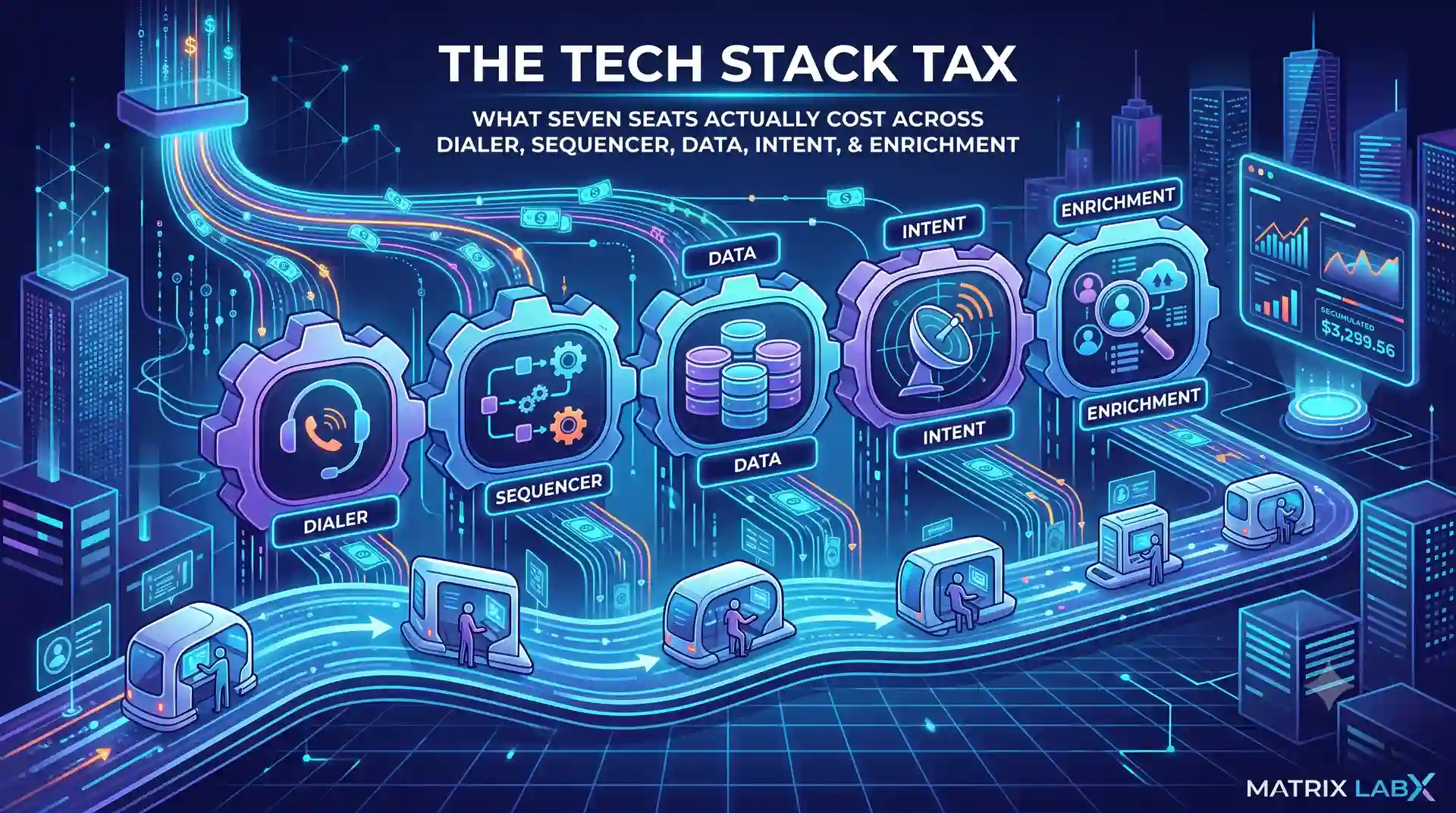
Seven SDR seats carry a tech stack of roughly $108K a year across the core five categories — sequencer (~$9K), parallel dialer (~$34K), data platform (~$29K), intent feed (~$30K), and enrichment credits (~$6K). Count the adjacent mandatory seats — CRM, LinkedIn Sales Navigator, conversation intelligence — and the all-in number reaches ~$137K a year, nearly $20K per seat. None of it scales with output; all of it scales with headcount.
Nobody buys a $137K sales stack. That would require a purchase order someone could challenge. Instead you buy a sequencer in Q1, a data platform at the sales kickoff, a dialer when connect rates crater, an intent feed when the board asks about "signal-based selling," and enrichment credits the week the data platform's coverage gaps become undeniable.
Each purchase is defensible. Each is priced per seat or per platform. And each renews annually with an 8–12% escalator, whether the team beat quota or missed it by half. This is the tech stack tax: a cost layer that scales with the number of humans you employ, not the amount of pipeline they produce.
This article prices the tax category by category for a seven-seat team — the tooling layer of the full model in The True Cost of a Seven-Person SDR Team. The compensation layer is covered in the multiplier breakdown.
» Key takeaways
- The core five categories cost ~$108K/year for seven seats — dialer and intent are the two heaviest lines, ~$30K each.
- All-in, the stack reaches ~$137K/year (~$20K/seat) once CRM, Sales Navigator, and conversation intelligence are counted.
- 20–30% of stack spend buys nothing — overlapping data add-ons, expiring credits, and licenses on empty seats.
- The tax is decoupled from output. Double the meetings, same bill. Miss quota, same bill. Renewal escalators raise it either way.
What does each category actually cost for seven seats?
Two pricing models drive the bill: per-seat lines that scale with headcount, and platform lines with high flat floors. Seven seats is large enough to feel the per-seat multiplication and small enough to be punished by the platform minimums — the worst of both.
Table 1 — Core five categories, seven seats, US mid-market list pricing (annual)
| Category | Pricing model | Typical price | 7-seat annual |
|---|
Sales engagement / sequencer
Outreach, Salesloft class | Per seat | ~$110/seat/mo | $9,240 |
Parallel dialer
Orum, Nooks class | Per seat | ~$400/seat/mo | $33,600 |
B2B data platform
ZoomInfo class | Platform + seats | ~$29K/yr floor | $29,400 |
Intent data
Bombora, 6sense class | Platform (flat) | ~$30K/yr entry | $30,000 |
Enrichment / waterfall credits
Clay, Apollo class | Credits | ~$500/mo team | $6,000 |
| Core five subtotal | — | — | $108,240 |
Then come the lines nobody assigns to "the SDR stack" but every SDR requires:
Table 2 — Adjacent mandatory seats (annual, 7 seats)
| Category | Typical price | 7-seat annual |
|---|
| CRM seats (Salesforce/HubSpot class) | ~$150/seat/mo | $12,600 |
| LinkedIn Sales Navigator | ~$92/seat/mo | $7,700 |
| Conversation intelligence (Gong class) | ~$100/seat/mo | $8,400 |
| All-in stack total | — | ≈ $137,000 |
» STACK_AUDIT — sdr_seats_x7# pricing the seat tax, category by category...
» sequencer $110/seat/mo × 7 = $9,240
» parallel_dialer $400/seat/mo × 7 = $33,600
» data_platform platform floor = $29,400
» intent_feed platform flat = $30,000
» enrichment credit packs = $6,000
» crm+navigator+ci per-seat adjacents = $28,700
# none of these lines reference pipeline produced
STACK TAX: ≈ $137K/yr — ~$19.6K per human seat
Why is so much of the stack spend wasted?
Because the categories were sold separately but do the same three jobs — find a contact, reach a contact, log the attempt — and every vendor bundles a partial version of the other vendors' jobs into its renewal.
The overlap is systematic, not accidental:
- Data is bought three times. The data platform sells contacts. The sequencer sells a data add-on. The enrichment layer re-verifies both. Coverage gaps in each drive purchase of the next.
- Credits expire; floors don't flex. Enrichment credits lapse monthly whether used or not; the intent platform's flat fee assumes an operations capacity most seven-person teams don't have — signals arrive, and nobody actions them.
- Empty seats stay licensed. Annual contracts meet mid-30s-percent turnover: when a rep leaves in March and the backfill starts in June, five licenses bill through the vacancy. Across a year, a meaningful share of per-seat spend covers chairs, not people.
- Renewal creep compounds. 8–12% annual escalators, per category, forever. The stack that costs $137K this year quotes $150K next year for identical capability.
Put a number on it: audits of mid-market sales stacks routinely find 20–30% of spend — $27K to $41K a year on this stack — buying nothing: unused credits, duplicate data, and licensed vacancies. That waste rate matches what we see at the full MarTech level, where 14-tool stacks carry millions in unused capability.
"When midmarket enterprises embed AI into their core operations, they eliminate bureaucratic drag, allowing them to out-maneuver larger competitors who are constrained by legacy silos."
» George Schildge · CEO & Chief AI Officer, MatrixLabX
» Stack audit
How much of your $137K stack is buying pipeline — and how much is buying shelf?
MatrixLabX audits every license, credit pack, and platform floor against the pipeline it actually touched. Most seven-seat teams recover 20–30% immediately — and then discover the entire category structure disappears when execution moves to governed agents.
~$20K
stack tax per human seat
20–30%
typical recoverable waste
Book a Discovery Call →
Why doesn't the stack cost scale with output?
Because every pricing model in the category is anchored to headcount or platform access — never to pipeline. That anchoring is the tax's defining property, and it breaks the unit economics in both directions.
Consider what happens at the extremes. If the team has a breakout year and doubles held meetings, the stack bill is unchanged — the vendors capture none of the upside, and neither does your cost-per-meeting math improve on the tooling line. If the team misses badly — or two seats sit vacant for a quarter — the bill is also unchanged: the tax is levied on capacity, and you already bought the capacity.
Now stack this on top of the labor economics. From the pillar model: seven seats deliver roughly 76% of theoretical capacity after ramp, vacancy, and turnover. The tooling follows the same curve — you license 100% of the seats and productive humans occupy about three-quarters of them. The effective stack cost per productive seat is not $19.6K; it is closer to $26K.
This is the deepest problem with the per-seat model, and it is not fixable by negotiation. A better rate on the dialer changes the slope, not the structure. As long as tools are priced per human and humans are the unit of production, the tax scales with the org chart.
What does the stack look like when agents do the work?
It stops being a stack. The five categories exist because a human SDR needs five interfaces to do one job. When the work moves to governed autonomous agents, data, enrichment, sequencing, and outreach are internal functions of one execution platform — not five contracts.
Under the PrescientIQ™ Sense → Decide → Act → Learn loop, the agent layer sources and enriches contacts, selects accounts on live intent signals, sequences and executes outreach, and writes every action back to the system of record — with a human approval gate on every send and an immutable audit ledger under all of it. The category-by-category comparison:
Table 3 — Per-seat stack vs governed agent execution
| Category | Seven-seat stack | Governed agent layer |
|---|
| Data + enrichment | ✕ 3 overlapping contracts | ✓ Internal function, continuously verified |
| Sequencer + dialer | ✕ ~$43K/yr in per-seat licenses | ✓ Execution native to the agent |
| Intent | ✕ $30K flat, signals unactioned | ✓ Sensed and actioned in the same loop |
| Pricing basis | ✕ Seats and platform floors | ✓ Outcomes — workflows executed |
| Empty-seat waste | ✕ Licensed vacancies bill on | ✓ No seats to leave empty |
| Governance | ✕ Five audit surfaces | ✓ One immutable ledger, governed by your team |
» Canonical definition
MatrixLabX replaces your fragmented SaaS stack with an autonomous digital workforce. We shift your business from Software as a Service to Labor as a Service. Our agents don't wait for prompts — they sense, decide, act, and learn 24/7 to deliver measurable P&L impact within 60 days.
The rest of the cost model, and the consolidation playbook:
Where this pricing will differ from yours
These are US mid-market list-price benchmarks, and stacks are negotiated goods. Multi-year commitments, bundling, and end-of-quarter discounts can pull 15–25% out of several lines; conversely, enterprise data contracts and premium intent tiers can double them. Teams that skip a category — no parallel dialer, no standalone intent — genuinely pay less, though usually by shifting the cost into connect rates or unfocused targeting rather than eliminating it. Rebuild the tables from your own renewal schedule before quoting a number internally. What survives every variant: the pricing is anchored to seats and platforms, not to pipeline — and that structure, not any individual price, is the tax.
People also ask
How much does the tech stack cost for a seven-person SDR team?
About $108K a year for the core five categories — sales engagement/sequencer (~$9K), parallel dialer (~$34K), data platform (~$29K), intent feed (~$30K), and enrichment credits (~$6K). Add CRM seats, LinkedIn Sales Navigator, and conversation intelligence and the all-in number reaches roughly $137K a year, or close to $20K per seat.
Which SDR stack category is the most expensive?
For a seven-seat team, the parallel dialer and the intent platform typically compete for the top line — each in the $30K-a-year range. Dialers price per seat, so their cost scales with headcount; intent platforms price at the account level, so they punish small teams with a high flat floor.
Why does per-seat pricing punish SDR teams specifically?
Because SDR teams combine high tool density with high turnover. Each seat needs five to eight licenses to function, licenses are bought on annual contracts, and mid-30s-percent annual turnover means a meaningful share of paid seats sit empty or half-ramped at any moment. You pay for 100% of the licenses and use roughly three-quarters of them.
How much of a typical sales stack is wasted?
Overlap and shelfware typically consume 20–30% of stack spend: sequencer and dialer both selling data add-ons you already buy elsewhere, enrichment credits expiring unused, intent signals nobody has time to action, and licenses assigned to empty seats. On a $137K stack that is $27K–$41K a year buying nothing.
Does the stack cost scale down if the team performs well?
No — that is the tax. Per-seat and platform pricing are fixed against headcount, not output. A team that doubles meetings pays the same stack bill; a team that misses quota pays the same stack bill. Renewal escalators of 8–12% a year mean the tax rises regardless of performance.
What replaces the per-seat stack model?
Consolidation into an execution platform where data, enrichment, sequencing, and outreach run as one governed system priced on work executed. MatrixLabX's PrescientIQ™ collapses the five-category stack into the agent layer itself, with no per-seat licenses, no overlap, and no empty-seat waste. Every action runs in the governance mode your team sets and is recorded to an immutable audit ledger.
» Free engagement · 24-hour response
You're paying ~$20K per seat for tools that never touch quota.
We audit every license against the pipeline it produced, recover the 20–30% buying nothing, and show you what the whole category structure costs when governed agents execute instead.
Book a Discovery Call →
» Deployment in 21 days or less · P&L impact within 60 days · matrixlabx.com/contact