Managed revenue operations for SaaS: what it takes off a RevOps manager’s plate, and how to prove the ROI
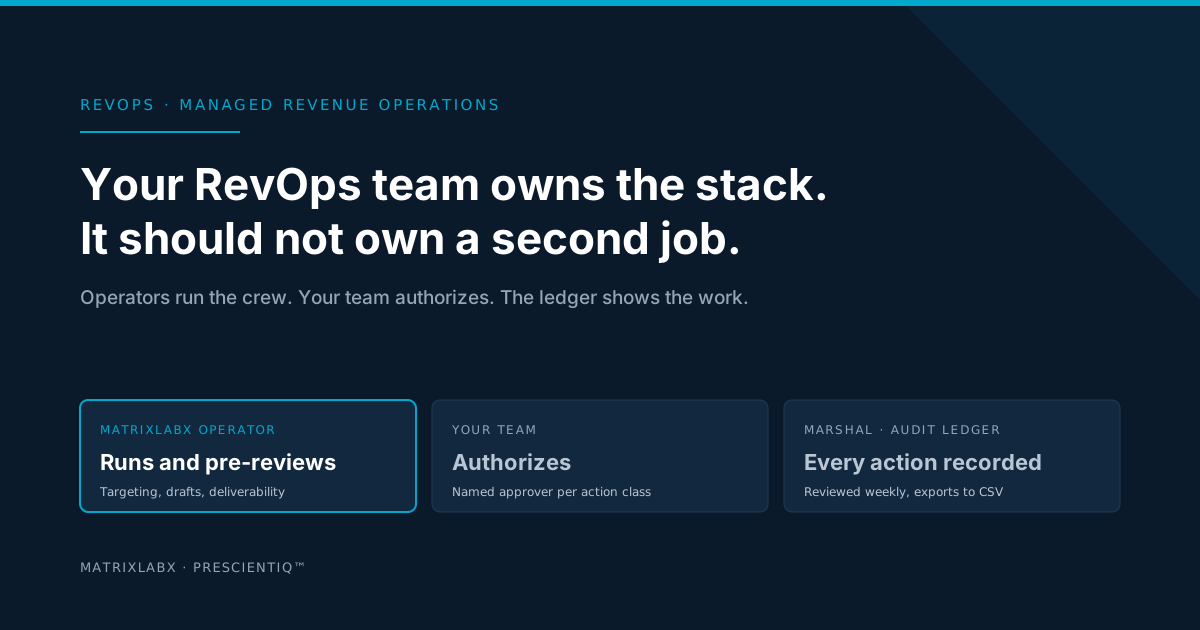
Managed revenue operations moves the running of AI revenue workers off the RevOps team. A named MatrixLabX operator runs PrescientIQ’s governed crew across prospecting, outbound, trial conversion, and expansion, and pre-reviews every draft. Your team keeps authorization, the CRM, and the rules. Every action is written to an audit ledger, which is what turns the ROI question into something a CFO can check. Pricing is published, from $8,999 a month, with no seats.
RevOps did not ask to run outbound. It asked for a cleaner CRM, a forecast it could defend, and fewer tools. Then AI arrived in the revenue stack, and every new tool came with a quiet assumption: that someone on the RevOps team would configure it, watch it, and answer for it.
This post is for RevOps managers and the CROs they report to at $20M–$500M ARR SaaS companies on Salesforce or HubSpot. It names the six jobs that land on RevOps when AI enters the revenue motion, shows what a managed operating team takes over and what RevOps keeps, compares six ways to get the work done, gives you a decision tree for which one fits, and sets out an ROI case you can check rather than one you have to trust.
What is managed revenue operations?
PrescientIQ™ Managed Revenue Operations is a done-for-you service from MatrixLabX. It runs on the same PrescientIQ platform MatrixLabX sells self-run, at the same published platform price, plus a managed-service fee for the people who operate it. The work follows five steps:
- Signal. Scout scores ICP-fit accounts; Guide and Steward watch trial and usage telemetry.
- Draft. Herald, Guide, or Steward prepares the action, grounded in the dated signal that triggered it.
- Operator pre-review. Your named MatrixLabX Revenue Operator edits, rejects with a retrain reason, or passes it on.
- Your authorization. A named person on your team approves, under the governance mode your team set for that action class.
- Ledger. Marshal writes the action, rationale, operator, and approver to the audit ledger, which you review weekly.
The difference from buying a tool is who carries the operating work. The difference from hiring an agency is who holds authority and who holds the record. Both differences land directly on the RevOps desk.
Which RevOps pain points does managed revenue operations relieve?
Each of the six below follows the same structure: what it looks like from the RevOps seat, what the managed operating team takes over, and what stays with you.
1. Who runs the AI we already bought?
What it looks like. Every AI revenue tool arrives with a second job attached: someone has to set the targeting, review the drafts, watch the domain, and report on what happened. That someone is usually RevOps. In a mid-2026 survey of more than 300 RevOps leaders, nearly one in four organizations said AI adoption had no clear owner at all.
What managed revenue operations takes over. A named MatrixLabX Revenue Operator tunes your ICP and scoring thresholds, pre-reviews every queued draft, and runs the weekly cadence. The operator is shared capacity on Pipeline Crew and dedicated capacity on Revenue Crew and Revenue Command.
What RevOps keeps. Authorization. Your operator can edit, reject with a retrain reason, or pass a draft on. Your named approver decides.
2. Signals pile up faster than anyone can act on them
What it looks like. The intent spike, the stalled trial, and the drop in seat utilization are all visible in a dashboard. The leak is the gap between the signal and the first action, and it opens on three stages at once: pipeline, activation, and expansion. RevOps can see it and cannot staff it.
What managed revenue operations takes over. Scout, the Pipeline Research Analyst, scores ICP-fit accounts. Guide, the Trial Activation Specialist, and Steward, the Expansion & Retention Analyst, watch trial and usage telemetry. Herald, the Outbound Engagement Rep, prepares the outreach. Outreach is grounded in the specific signal that triggered it, with the reasoning behind each draft captured alongside it. Operator pre-review runs to a published service level: 1 business day on Pipeline Crew, 4 business hours on Revenue Crew and Revenue Command.
What RevOps keeps. Which lanes run, in what order, and the ICP and disqualifiers the crew works against.
3. Deliverability and domain risk land on RevOps
What it looks like. Outbound at volume is a domain-health job: SPF, DKIM, and DMARC, suppression lists, frequency caps, bounce handling. When a sending domain degrades, it is RevOps who gets the ticket, usually from the AE whose replies stopped arriving.
What managed revenue operations takes over. On Revenue Crew and Revenue Command, a Deliverability & Data Engineer owns authentication, domain health, suppression and frequency rules, and CRM writeback accuracy, continuously. Pipeline Crew includes deliverability setup and a monthly health check. Incident response has a published service level on every tier.
What RevOps keeps. The written suppression and frequency rules, which are a prerequisite before any lane starts.
4. Agents writing to the CRM you are accountable for
What it looks like. RevOps owns the system of record, so any tool that writes to it is RevOps’s problem when a field goes wrong. In the same survey, poor data quality was the single most-cited barrier to AI adoption, named by 19% of respondents. An agent that writes without recording what it changed makes that problem invisible.
What managed revenue operations takes over. Every action, in either mode, is recorded to the audit ledger with its rationale, before-and-after state, and the approver or policy behind it. Marshal, the Revenue Operations Coordinator, writes each entry, and the ledger exports to CSV.
What RevOps keeps. The CRM itself. Salesforce or HubSpot stays the system of record, and the ledger is yours to export.
5. The CFO wants ROI you can trace, not a vendor percentage
What it looks like. In the same survey, fewer than 9% of RevOps leaders said AI had helped generate more pipeline; most reported time saved instead. Time saved is hard to defend in a budget review. Gartner predicts that more than 40% of agentic AI projects will be canceled by the end of 2027, naming escalating costs, unclear business value, and inadequate risk controls.
What managed revenue operations takes over. A weekly ledger report on every tier, and a definition of the unit that matters: a sales-accepted opportunity is an opportunity your AE accepts in your CRM, traced in the audit ledger to the workflow that produced it. The ROI section below shows how that turns into a number your CFO can check.
What RevOps keeps. The baseline. Your team decides what the managed lane is measured against before it starts.
6. Approval and accountability for what goes out under your name
What it looks like. When a prospect asks who sent a message, or security asks what touched a record, RevOps is expected to have the answer. Most tools leave that to configuration, and configuration drifts.
What managed revenue operations takes over. Your team chooses the mode for each action class, based on its risk tolerance, and can change it at any time. Human-in-the-loop (HITL): The action is drafted and held. It does not execute until a named person on your team approves it. Human-on-the-loop (HOTL): The action executes under a standing policy your team sets. A named person supervises and keeps intervention, override, and revocation authority. Every action class starts in human-in-the-loop until your team changes it. Outbound messages from Herald and Guide are held for a named person’s approval. Delegated authorization to your MatrixLabX operator is optional, in writing, limited to low-risk action classes you name, revocable at any time, and never the default.
What RevOps keeps. The governance mode for every action class, and the named approver for each.
What does a RevOps manager get back?
| Workload | Today | With managed revenue operations | RevOps keeps |
|---|---|---|---|
| Running AI revenue workers | RevOps, on top of the day job | Named MatrixLabX Revenue Operator | Approval authority |
| Acting on signals across three funnel stages | Whoever has time | Scout, Herald, Guide, Steward, pre-reviewed to a published service level | Lane priority and the ICP |
| Deliverability and domain health | RevOps, after the AE complains | Deliverability & Data Engineer (setup and monthly check on Pipeline Crew) | Suppression and frequency rules |
| CRM writeback accuracy | RevOps cleanup cycles | Recorded before-and-after on every action | The CRM as system of record |
| ROI reporting to finance | Spreadsheet reconstruction | Weekly ledger report; SAOs traced to workflows | The baseline |
| Accountability for sends | Tool settings | Held for your named approver; ledger entry for every decision | Governance mode per action class |
How does managed revenue operations compare with the alternatives?
Six ways to get top-of-funnel and lifecycle revenue work done, read from the RevOps seat. The last column is the one most comparisons leave out: what still lands on your team.
| Option | Typical monthly cost | Who does the work | Who reviews before send | Audit trail | What lands on RevOps |
|---|---|---|---|---|---|
| In-house SDR, fully loaded | ~$10,550–$10,870/mo per SDR | Your hire | Your SDR manager, when there is time | CRM activity history | Backfill, ramp, per-seat tooling, and the data hygiene behind every rep |
| Outsourced SDR agency | $3,000–$15,000/mo | Agency staff, in the agency’s process | The agency | Agency reporting; format varies | Getting agency activity into the CRM, attribution disputes, and contract terms of 3–12 months |
| AI SDR tool, self-run | From $3,750/mo on annual plans | Your team | Varies by tool and configuration | Varies by tool and plan | All of it: targeting, the review queue, deliverability, and reporting |
| Fractional revenue leader | $3,000–$15,000/mo | Strategy from the leader; execution by your team | Your team | None by default | Executing the plan the leader writes |
| PrescientIQ, self-run | From $399/mo (Starter, billed annually) | Governed digital workers, configured by your team | Your named approver | Immutable audit ledger | Configuring the crew, staffing the approval queue, and deliverability |
| Managed Revenue Operations, Pipeline Crew | $8,999/mo, published | Governed digital workers, run by a named MatrixLabX operator | Your MatrixLabX operator, then your named approver | Immutable audit ledger; exports to CSV | Approvals per action class and the weekly ledger review |
- In-house SDR, fully loaded, $126,600–$130,400/yr (~$10,550–$10,870/mo): source
- Outsourced SDR market range, $3,000–$15,000/mo: source
- Agency contract terms, 3–12 months common: source
- Entry AI SDR plan, annual, $3,750/mo billed annually ($45,000/yr): source
- Fractional RevOps leadership retainer, $3,000–$15,000/mo: source
Figures are vendor- or analyst-reported as of October 2026. Category figures, not quotes for any one vendor.
Each managed comparison has its own page with the full criteria and the cases where the alternative is the better call: vs. an in-house SDR team, vs. an SDR agency, and vs. an AI SDR tool.
When managed revenue operations is the wrong call
- Live cold calling is the motion. Telephony and SMS are not included. An agency with phone reps fits better.
- You already have the operator. If someone on RevOps has real weekly hours to run and govern the crew, self-run PrescientIQ or a tool avoids paying for duplicate capacity.
- You are building an SDR-to-AE bench. If the seat is how you grow your next account executives, a managed service does not provide that path.
- You need closing or AE work. Closing, legal determinations on outreach rules, and guaranteed meeting or pipeline figures are outside the service.
Decision tree: which path fits your RevOps team?
Answer with your current team in mind, not the one in next year’s plan. Whatever the path, every action class begins in human-in-the-loop, and autonomy rises only on evidence from the ledger; the framework for that call is in human-in-the-loop vs. human-on-the-loop.
Should you run it, buy it run, or hire for it?
Read the decision tree as text
- If someone on RevOps has real weekly hours to run an AI revenue crew and outbound email is the only gap, run a self-run tool or PrescientIQ Sales Accelerator.
- If that person exists and trials or expansion also leak, run PrescientIQ yourself across the funnel and add management later if needed.
- If no one has the hours and live cold calling is the primary motion, an agency with phone reps fits better.
- If no one has the hours and the revenue leak is in one stage, start with Pipeline Crew ($8,999 a month, one motion lane).
- If no one has the hours and several stages leak, choose Revenue Crew ($24,000 a month), or Revenue Command ($34,500 a month) when the CRO seat is open or you need forecast governance and board reporting.
How do you prove the ROI of managed revenue operations?
Start with what we will not say. PrescientIQ is in a founding pilot program, and MatrixLabX publishes no customer outcomes yet. The Founding Ten program exists to change that: the first ten managed clients publish ledger-measured results at day 90. Until then, the honest ROI case is one you can check yourself, on three lines.
Line 1: the cost side is arithmetic on published prices
In the MatrixLabX cost model, one US mid-market SDR on a $62,000 base costs $126,600 a year fully loaded, about 2.04× base, once variable comp, payroll tax, benefits, equipment, recruiting, and ramp are counted. Pipeline Crew costs $107,988 a year for one full motion lane, platform and operator included. The difference, $18,612 a year, is arithmetic on a published price and a documented model, not an outcome. Swap in your own comp data with the fully loaded SDR cost calculator; the line-by-line model is in base salary vs. fully loaded SDR cost.
Line 2: the outcome side is counted in the ledger
The unit is the sales-accepted opportunity (SAO): An opportunity your AE accepts in your CRM, traced in the audit ledger to the workflow that produced it. Because each SAO traces to the workflow that produced it, finance can reconcile it rather than take it on trust. If you want the fee to move with that count, the performance-indexed option takes 30% off the managed-service fee and adds $400 per SAO, capped at 130% of the standard service fee. On Pipeline Crew, that is a $5,460 base service fee, a break-even of 5.85 SAOs a month against the standard price, and a service-fee cap of $10,140. The platform fee is never indexed.
Line 3: lane targets are labeled as targets
Where MatrixLabX states a performance figure, it carries its label. On the trial conversion lane, the registered figure is a modeled target, scoped to trials Guide intervenes on before a stall:
Figures labeled as targets are modeled against current human and copilot baselines. They are not guarantees. Every engagement begins with a free Autonomous Audit Report — a P&L projection built on your own data — and targets are validated against your environment before any commitment.
Every engagement begins with the free Autonomous Audit Report: a P&L projection built on your own CRM data, read-only, with every figure labeled as modeled, and a priced managed proposal. Your CFO checks the assumptions before anyone signs. The questions finance will ask are in the 2027 AI budget review.
The risk side: published terms
- Contract. Annual agreement, billed monthly, net 30.
- Exit. Exit right at day 90 on 15 days' notice.
- Service credit. 10% of that month's managed-service fee if a commitment misses in more than 10% of instances in a month.
- Agency switch credit. Month one of the managed-service component at 50% for clients exiting an outsourced SDR contract.
- Seats. None. Approvers are unlimited, so adding reviewers never changes the invoice.
Next step
Write down the six workloads above and, next to each, the name of the person on your team who carries it today and the hours it takes. Where the name is blank or the hours are not real, that is the work to hand off. Where they are real, keep it, and run PrescientIQ yourself. The full service, lanes, and team are on the managed revenue operations page; the lanes are outbound, trial conversion, and expansion and retention.
Frequently Asked Questions
- What is managed revenue operations?
- Managed revenue operations is a done-for-you service in which MatrixLabX operators run PrescientIQ’s governed AI workers for your revenue team across prospecting, outbound, trial conversion, and expansion. The operator tunes targeting, pre-reviews every queued draft, and reports weekly from the audit ledger, while your team keeps authorization.
- How does managed revenue operations help a RevOps manager?
- Managed revenue operations takes the running of AI revenue workers off the RevOps team: targeting, draft review, deliverability, and weekly reporting move to a named MatrixLabX operator. RevOps keeps the decisions that matter, including approvers, governance mode per action class, suppression rules, and the CRM as system of record.
- Is managed revenue operations the same as a fractional RevOps leader?
- No. A fractional RevOps leader sets strategy and process, and your team still executes it. MatrixLabX Managed Revenue Operations executes the work: governed AI workers act on signals, a named operator runs them, and a named person on your team approves before outbound sends. Revenue Command adds fractional revenue leadership two days a week.
- How much does managed revenue operations cost?
- MatrixLabX Managed Revenue Operations costs $8,999 a month for Pipeline Crew, $24,000 for Revenue Crew, and $34,500 for Revenue Command. Each price is the published PrescientIQ platform fee plus a managed-service fee. There are no seats, approvers are unlimited, and the agreement is annual and billed monthly.
- Does MatrixLabX guarantee pipeline or ROI from managed revenue operations?
- No. MatrixLabX commits to what it controls: operator review times, weekly ledger reporting, and deliverability response, with service credits for misses. Shared risk is available through the performance-indexed option, which ties part of the service fee to sales-accepted opportunities traced in the audit ledger to the workflow that produced them.
- Who approves outbound messages in managed revenue operations?
- A named person on your team approves outbound messages. In MatrixLabX Managed Revenue Operations, every outbound draft from Herald and Guide is held in the PrescientIQ approval queue, pre-reviewed by your MatrixLabX operator, and approved by your named approver before it sends. Every decision is written to the audit ledger.
- What does a RevOps team still own under managed revenue operations?
- Under managed revenue operations, the RevOps team still owns the CRM as system of record, the ICP and its disqualifiers, suppression and frequency rules, the governance mode for each action class, and who approves what. MatrixLabX owns running the crew, pre-review, deliverability work by tier, and the weekly ledger report.
- Can we exit managed revenue operations if it is not working?
- Yes. MatrixLabX Managed Revenue Operations is an annual agreement billed monthly with an exit right at day 90 on 15 days’ notice. The audit ledger exports to CSV and your CRM stays the system of record, so the record of every action stays with your team after an exit.
Related Reading
- Managed revenue operations pricing, every tier itemized
- RevOps in 2027: the three concerns that will decide whether your AI plan survives
- The 2027 RevOps Survival Blueprint
- The audit ledger is the new system of record for agent actions
- Why your CRM data decays faster than your cleanup cycle
- PrescientIQ for B2B SaaS
Sources and notes
- The State of AI in Revenue Operations: H1 2026 Report (survey of more than 300 RevOps leaders, June 11, 2026)
- Gartner, “Gartner Predicts Over 40% of Agentic AI Projects Will Be Canceled by End of 2027,” June 25, 2025
Survey and analyst figures were checked against their linked sources on October 12, 2026; the Gartner figure is a prediction, not a measurement. Category cost figures are vendor- or analyst-reported and linked in the comparison above. The SDR cost difference is arithmetic on MatrixLabX’s published price and cost model. No PrescientIQ customer outcome is claimed, and product statements match the current public copy.
See where your own execution effort is going
The Autonomous Audit Report models where your team's execution capacity is currently spent, what your configuration is actually paying for, and what the governed alternative looks like on your own data — before any commitment.
Get your free AAR benchmark