How PrescientIQ finds revenue gaps in mid-market manufacturing, and what closes each one
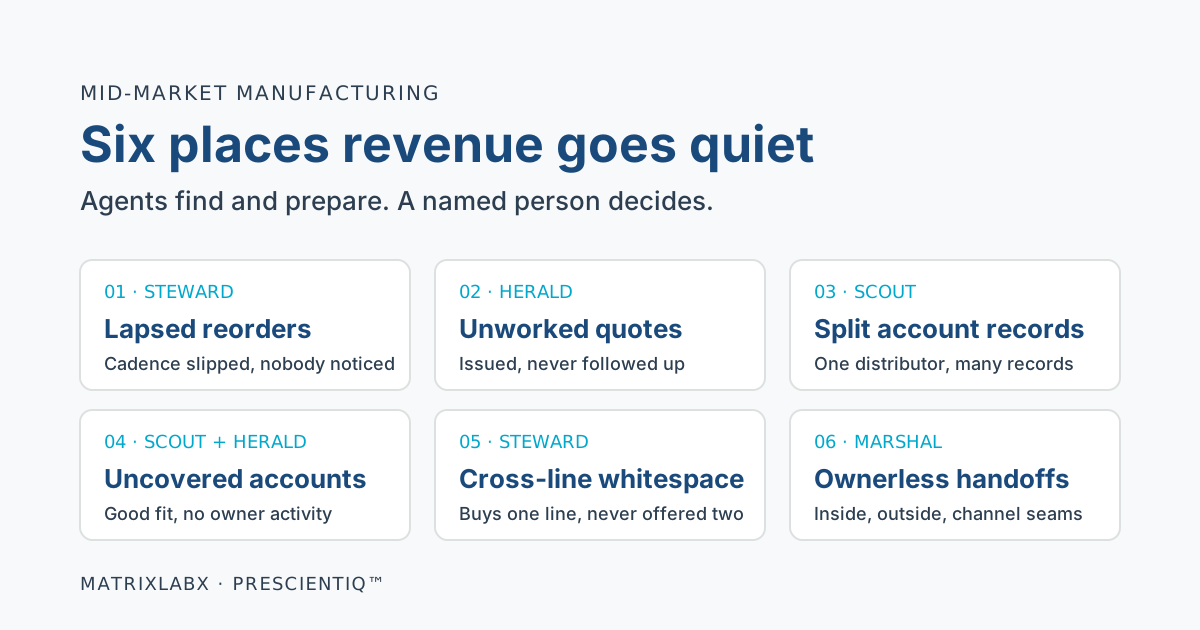
Mid-market manufacturers rarely lose revenue for lack of demand. They lose it in work nobody owns: distributor reorders that lapse unnoticed, quotes nobody follows up, one account split across five records, good-fit accounts no rep touches, customers never offered the adjacent product line, and handoffs between inside sales, outside sales, and the channel. PrescientIQ finds each gap in your own CRM through a free, read-only Autonomous Audit Report, pairs it with the agent that would prepare the work, and leaves every customer-facing decision with a named person on your team.
Why do mid-market manufacturers leak revenue they already earned?
A manufacturer between $20M and $500M in revenue usually sells through several motions at once: direct accounts, distributors, dealers, and OEM buyers, each with its own cadence. The commercial team is sized for the accounts that shout. Everything quieter is handled when someone has time.
That is where the leak sits. Not in the big deal that was lost, which everyone reviews, but in the reorder that never came and nobody noticed, and the quote that expired in an inbox. None of it shows up as a loss on a dashboard, because nothing was ever opened. It shows up as a quarter that came in light for reasons no one can name.
The pattern is the same one we describe for the whole revenue organization in how to fix revenue leakage between marketing, sales, and customer success: revenue leaks at the seams between owners, not inside any one team. In manufacturing the seams multiply, because the channel adds owners you do not employ.
What are the six revenue gaps PrescientIQ looks for?
Each gap below is something a manufacturer’s own records can show, which is what makes it findable. The table pairs each one with the PrescientIQ agent that prepares the work and the person who decides it.
| Gap | Where it shows up | Who prepares the fix | What a person decides |
|---|---|---|---|
| 1. Lapsed reorders | Distributor and dealer accounts whose ordering cadence has slipped, with no activity logged since | Steward flags the account and prepares a re-engagement play | The account owner approves, edits, or rejects the outreach |
| 2. Unworked quotes | Quotes issued with no follow-up activity recorded against them | Herald drafts a follow-up grounded in the quote that triggered it | The rep who owns the quote approves the draft before it reaches the buyer |
| 3. Split account records | One distributor, OEM, or dealer group spread across several records and parents, so its signals never add up | Scout surfaces likely duplicates and hierarchy mismatches and proposes merges | RevOps confirms each merge, or sets a standing policy for low-risk ones |
| 4. Uncovered accounts | Accounts that match your best customers but have no owner or no recent activity | Scout researches and scores them, then hands qualified accounts to Herald | A named approver releases every first touch |
| 5. Cross-line whitespace | Customers buying one product line who have never been offered the adjacent one | Steward flags the opening and drafts an expansion proposal | The account owner decides whether and when to raise it |
| 6. Ownerless handoffs | Opportunities that move between inside sales, outside sales, and channel partners and stall at the seam | Marshal routes the work to the right specialist and records every step | RevOps writes the routing rules once and reviews the ledger |
1. Lapsed reorders
A distributor that ordered every few weeks for two years and then went quiet is the most expensive silence in manufacturing, because the relationship, the pricing, and the qualification are already done. The usual reason nobody notices is structural: the account is too small to have a dedicated rep, and the quarterly review happens after the competitor has taken the slot.
Steward, PrescientIQ’s Expansion & Retention Analyst, reads post-sale signals between reviews instead of at them, flags the account whose cadence has slipped, and prepares a re-engagement play for the owner. How Steward reads, flags, and hands off is covered in inside Steward. On the supply side, the same cadence problem drives overstock and stockouts, which is the subject of autonomous demand forecasting agents for mid-market manufacturers.
2. Unworked quotes
Quote-to-close cycles in manufacturing are long and involve engineering, purchasing, and sometimes the end customer behind a distributor. Each quote that goes out without a recorded follow-up is a buyer who asked for a price and then heard nothing. Reps are not ignoring them. They are working the quotes that are already moving.
Herald, PrescientIQ’s Outbound Engagement Rep, treats the open quote as the trigger and drafts a follow-up grounded in it: the part, the quantity, the question the buyer asked. The draft is held until the rep who owns the quote approves, edits, or rejects it. The approval mechanics are in inside Herald.
3. Split account records
Distributor groups, OEM divisions, and dealer networks tend to enter a CRM several times, under different names, parents, and sites. When that happens, buying signals land on different records and never add up to a pattern anyone would act on. This is the gap the other five depend on: a reorder cadence cannot be read across three records that do not know they are one customer.
Scout, PrescientIQ’s Pipeline Research Analyst, surfaces likely duplicates and hierarchy mismatches and proposes the merge. A person confirms it, unless your team has moved low-risk merges to a standing policy. The full treatment is in CRM debt is costing manufacturing tech companies their best buyer signals, and the general version is how to deploy agents on the CRM you actually have.
4. Uncovered accounts
Every manufacturer has accounts that look exactly like its best customers and have never been worked: no owner, or an owner with no logged activity in a year. Territory plans assign them; capacity never reaches them.
Scout researches and scores these accounts against the profile of the customers you already win, then hands qualified accounts to Herald for a first touch that a named approver releases. The profile itself should come from your own closed deals, as set out in how to define a B2B ideal customer profile from your own closed deals.
5. Cross-line whitespace
A customer that buys fasteners and has never been offered the matching tooling is whitespace your own order history already describes. It stays whitespace because product-line specialists sell their own line, and nobody owns the gap between them.
Steward flags the opening on the account and drafts an expansion proposal. Whether and when to raise it stays with the account owner, who knows whether this is the quarter to ask.
6. Ownerless handoffs
An inquiry that arrives through a distributor, gets qualified by inside sales, and needs an outside rep for a site visit has three owners and, at each seam, none. Opportunities stall there without ever being lost.
Marshal, PrescientIQ’s Revenue Operations Coordinator, routes work across the agents by rules your team writes once, and records every step to the audit ledger, so a stalled handoff is visible as a stalled handoff rather than as a quiet account.
How does PrescientIQ identify these gaps in your data?
The gaps are found the same way for every manufacturer: on its own records, before any commitment. The vehicle is the free Autonomous Audit Report (AAR), and it runs in five steps.
- Intake session. Your team names the product lines, channels, and account types that matter, and the revenue questions leadership is already asking.
- Read-only review of the CRM. A solution architect reviews your Salesforce or HubSpot data. Nothing is written to your CRM during the assessment.
- Gap mapping. Each of the six gaps is tested against your own records: which accounts show a lapsed cadence, which quotes have no follow-up, where records split, which good-fit accounts nobody works.
- Fix mapping. Every gap the data supports is paired with the agent that would prepare the work and the named person who would decide it, so the governance design is part of the finding, not an afterthought.
- P&L projection on your data. The projected impact is modeled on your own CRM and pipeline. Modeled figures carry a Target label and are validated against your environment before any commitment.
The written assessment comes back within 48 hours of the intake session. It names which of the six gaps your data actually shows, which it does not, and what the governed fix would look like for each. A gap your data does not support is reported as absent, not estimated.
One scope note matters for manufacturers. PrescientIQ connects to Salesforce and HubSpot today, and order history usually lives in the ERP. The AAR establishes how much of that history already reaches your CRM and what integration scope the gaps you care about would need, and that scope is quoted before anything is signed.
Who decides what, once the gaps are found?
Finding a gap is internal work. Closing it usually means contacting a distributor, dealer, or OEM buyer under your company’s name, which cannot be undone. PrescientIQ separates the two. Your team sets the oversight mode for each action class, and the two modes are defined as follows.
Human-in-the-loop (HITL). The action is drafted and held. It does not execute until a named person on your team approves it.
Human-on-the-loop (HOTL). The action executes under a standing policy your team sets. A named person supervises and keeps intervention, override, and revocation authority.
Your team chooses the mode for each action class, based on its risk tolerance, and can change it at any time.
Every action, in either mode, is recorded to the audit ledger with its rationale, before-and-after state, and the approver or policy behind it.
Every action class starts in human-in-the-loop until your team changes it.
In practice, manufacturers tend to settle internal work (scoring accounts, flagging a lapsed cadence, proposing a merge, preparing a draft) and customer-facing work in different places. Every message Herald prepares for a buyer is held until a named person approves it. The reasoning for setting the ceiling by where an error lands is in human-in-the-loop vs. human-on-the-loop.
Agents find the gap and prepare the work. The person who owns the customer relationship decides what reaches the customer.
What does this look like for one manufacturer?
Illustrative scenario. The company is fictional and the scenario carries no figures; it shows the sequence, not an outcome.
A components manufacturer sells direct to OEMs and through a regional distributor network, with an inside sales team and a handful of outside reps. Leadership’s question going into the AAR is why distributor revenue is flat while the number of active distributors has not changed.
The review finds three of the six gaps. Several distributor groups exist as multiple records, so their combined ordering never looked like one account (gap 3). Once those records are read together, a set of distributors shows a cadence that slipped and was never followed up (gap 1). And quotes issued to OEM buyers often carry no recorded follow-up after the first week (gap 2). Cross-line whitespace is present but small, and is reported as such.
The proposed design sequences the work: Scout’s proposed merges go first, confirmed by RevOps, because the other two fixes read across those records. Steward then flags lapsed accounts to their owners with a prepared play, and Herald drafts quote follow-ups that each owning rep approves. The projected P&L impact is modeled on the company’s own data and labeled as a target.
When is this the wrong move?
Governed agents are not the first fix for every manufacturer. Look elsewhere first if any of these is true.
- Accounts, quotes, and opportunities do not live in a CRM, or the CRM is a contact list nobody updates.
- Nearly all volume runs through one or two distributors your team already speaks with every week.
- Nobody can be named to approve outreach in each coverage window. An approval queue with no approver moves the bottleneck rather than removing it.
- The real constraint is production capacity or lead time, not demand. More orders would make that worse, not better.
The broader readiness test, six dimensions and a self-score, is in AI readiness assessment for revenue teams.
Find the gaps in your own CRM
Which of the six gaps is costing you is a question about your records, not about manufacturing in general. The free Autonomous Audit Report answers it read-only, on your own data, and returns a written assessment within 48 hours of the intake session, before any commitment. The full commercial and technical scope of the governed crew is on the Revenue Accelerator Stack page, and the argument behind it, that execution capacity rather than software access is the constraint, is in what is digital labor.
Digital workers execute. Humans authorize.
Where the data runs
PrescientIQ is hosted and operated by MatrixLabX on Google Cloud. SOC 2, ISO 27001, and PCI DSS attestations are held by Google Cloud, which operates the underlying infrastructure. They are not MatrixLabX certifications. MatrixLabX application-layer SOC 2 is in progress.
Frequently Asked Questions
- Where do mid-market manufacturers most often lose revenue?
- Mid-market manufacturers most often lose revenue in work nobody owns: distributor reorders that lapse unnoticed, quotes issued without follow-up, duplicate account records that split buying signals, good-fit accounts with no rep activity, customers never offered adjacent product lines, and handoffs between inside sales, outside sales, and channel partners.
- How does PrescientIQ identify revenue gaps for a manufacturer?
- PrescientIQ identifies revenue gaps through the free Autonomous Audit Report. After an intake session, a solution architect reviews your CRM read-only, maps which of the six gaps your records show, and models the projected P&L impact on your own data. The written assessment comes back within 48 hours of the intake session.
- Which PrescientIQ agents apply to a manufacturing company?
- For most manufacturers, three PrescientIQ agents do the work: Scout researches and scores accounts, Herald drafts outreach grounded in a signal, and Steward flags lapsed reorders and cross-sell openings. Marshal coordinates them and records every action. Guide, the trial activation agent, is built for software trials and rarely applies.
- Does PrescientIQ contact distributors without a person approving it?
- No. Herald’s outreach to a distributor, dealer, or OEM buyer is drafted and held until a named person on your team approves, edits, or rejects it. Internal work, such as scoring accounts or proposing a record merge, follows the governance mode your team sets for that action class, and every action is logged.
- Does PrescientIQ connect to ERP systems?
- PrescientIQ connects to Salesforce and HubSpot today, plus licensed intent-data providers. Order history usually lives in the ERP, so the Autonomous Audit Report establishes how much of it already reaches your CRM and what integration scope is needed. That scope is quoted before you sign, not discovered after deployment.
- When is PrescientIQ the wrong fit for a manufacturer?
- PrescientIQ is the wrong fit when the CRM is not where accounts and opportunities live, when nearly all volume runs through one or two distributors your team already talks to weekly, or when no one can be named to approve outreach. In those cases, a process fix or another hire is the better first move.
Related Reading
Notes on this page
This page contains no MatrixLabX performance figures and no third-party statistics. The six-gap framework and the assessment method are MatrixLabX’s own. The manufacturer in the scenario is fictional, and the scenario describes a sequence of work, not a measured result. Any projected impact for your company is modeled on your own data in the Autonomous Audit Report and labeled as a target until validated.
See where your own execution effort is going
The Autonomous Audit Report models where your team's execution capacity is currently spent, what your configuration is actually paying for, and what the governed alternative looks like on your own data — before any commitment.
Get your free AAR benchmark